• ******* To read about the changes to the marketplace click here

External pump without drilling sump?

You suck the air out manually. as in put the hose in your mouth and suck until you see water in the airline, then close the valve. It will not need to be reprimed, the water stays in the bottom of the U shape of the tube when the power is cut.
 
thanks for the replys. Not sure which way I'm going to go yet. The 55 gallon sump is going under a 90 gallon stand I custom made so space will be tight. Would have to drill the front panel and not the end. It is an old tank (1997) I think the sticker said. Sticker did say tempered glass but the sticker is on the bottom panel. So what do I look for with the polarized glasses? How will a tempered panel look compared to a non tempered panel under the glasses.
 
I ran my system like this for a couple of years and had no problems with it. Not the best option, but it works. Personally, now, I would just drill it, or if it can't be drilled, get one that can. But, if you must, this will work...

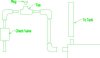
This is sloppy exploded view of what I ran, you just loosen the plug on top of the U tube until the water pressure from the display fills the U tube and all the air escapes, then snug it down and start up your pump.
 

Attachments

  • OVER SUMP.jpg
    OVER SUMP.jpg
    14.8 KB · Views: 306
Dave,

I'm puzzled about the purpose of the check valve, maybe I need to give it more thought.

Jim
 
I ran a blueline 20 to an etss skimmer like this for a year, it only needed the initial prime as long as the intake tube was actually higher than the pump itself. I think I only had an 8" waterlevel in the sump. It would self prime consistently even when doing waterchanges and emptying the sump as long as i shut it off prior to draining the water in the sump.

I used no checkvalves or shutoff valves.
 
Dave,

Forget my question.....:confused: I think this is the only way it can work.

Jim
 
If there's no air inlet at the top of the upside down U-tube, then that will remain full of water. Suction will keep that u-tube full. Just like a HOB overflow. As long as the sump water level doesn't drop and admit air, priming shouldn't be an issue.

That said, I'd see if I could just drill it as a first choice.

Maybe I missing something but the tank side of the plumbing is vented to prevent the tank from flooding into the sump.

Jim
 
As long as the u pipe that goes up and over does not have too much volume it should work fine without a check valve. To put it another way, as long as enough water stays inside the pump and the plumping when it's restarted it will pump that volume of water up which will suck water up the intake side of the U, and as long as there is more water in the plumbing than air in the intake side of the U, the pump will suck up the bubble and re-prime itself.

I know that was hard to follow, but I can't find better words to convey it. Whatever the case I've run a tank that way for a couple years and it's never lost prime.

 
As long as the u pipe that goes up and over does not have too much volume it should work fine without a check valve. To put it another way, as long as enough water stays inside the pump and the plumping when it's restarted it will pump that volume of water up which will suck water up the intake side of the U, and as long as there is more water in the plumbing than air in the intake side of the U, the pump will suck up the bubble and re-prime itself.

I know that was hard to follow, but I can't find better words to convey it. Whatever the case I've run a tank that way for a couple years and it's never lost prime.

That's just what I was saying in post #9, but without the check valve, like in Dave's sketch, the U tube will fill with air, If not to much air the pump may burp but then re-prime.

Jim
 
Last edited:
I ran the check valve just to prevent excess water siphoning back into the sump, it could only drain so much anyway, but I figured the less the better, plus, no burp, the system is always full top to bottom after the initial start.
 
That's just what I was saying in post #9, but without the check valve, like in Dave's sketch, the U tube will fill with air, If not to much air the pump may burp but then re-prime.

Jim

I think you are wrong.

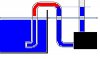
Same layout as Daves' pic, but no checkvalve. The blue line represents the water level in the sump. The power gets cut draining the return line to the water level in the sump, how does air get into the U-tube?

UtubeDiagram.jpg
 
I take this cap off the 1st time to prime....has held prime ever since
 

Attachments

  • P1010029.JPG
    P1010029.JPG
    61.5 KB · Views: 300
The only addition I would add is to add a true union ball valve right in front of the pump for maintenance
 
I think you are wrong.

Same layout as Daves' pic, but no checkvalve. The blue line represents the water level in the sump. The power gets cut draining the return line to the water level in the sump, how does air get into the U-tube?

UtubeDiagram.jpg

It comes in through the vented side (in this sketch the right) much like your kitchen sink, when the pump turns off the water and air flow back into the sump clearing the pipe. Looking at your water level line on the sketch it is not possible for the level on the intake side of the pump (the U tube) to be at a higher level than the output, it's a simple vented U tube, it could not support the water elevation on one side without transferring to the other, and then spilling into the sump.

Jim
 
The only addition I would add is to add a true union ball valve right in front of the pump for maintenance

A couple of ball valves would be nice right close too, less mess when maintenance time comes around.
 
I think you are wrong.

Same layout as Daves' pic, but no checkvalve. The blue line represents the water level in the sump. The power gets cut draining the return line to the water level in the sump, how does air get into the U-tube?

UtubeDiagram.jpg


The the water line that really matters is what will stay in the pump housing and the inlet and outlet pipes as they go straight up from the pump. So this line would be the bottom of the elbow across the top, over to the same height in the return pipe (that's what will actually stay full of water when the pump is shut off).

Now look at the sump level line again - from there, up and over to the elbow going down (where the water level will stop in the pump side of the plumbing) is the air volume that you need to worry about. As long as that air space isn't more than the total water volume that will sucked in by the pump before the bubble finishes it's burp phase - the pump will burp quickly and then be reprimed.

My version of the pic. Red is the airspace I'm talking about, and the blue is corrected to show how I believe it will sit when the power is off.
 

Attachments

  • drawing.jpg
    drawing.jpg
    17.1 KB · Views: 277
It comes in through the vented side (in this sketch the right) much like your kitchen sink, when the pump turns off the water and air flow back into the sump clearing the pipe. Looking at your water level line on the sketch it is not possible for the level on the intake side of the pump (the U tube) to be at a higher level than the output, it's a simple vented U tube, it could not support the water elevation on one side without transferring to the other, and then spilling into the sump.

Jim

The water will only drop as low as the level in the sump, it can't drop lower that. For air to get into to top of the U tube the water would have to drop lower than the level in the sump which defies the law of gravity.
 
The water will only drop as low as the level in the sump, it can't drop lower that. For air to get into to top of the U tube the water would have to drop lower than the level in the sump which defies the law of gravity.

I think you need to read my last post....again. You are looking at this from the exit end with no thought to the the supply side when the pump stops.

Jim
 
I just simulated this with a bucket of water and a hose and this is what happened. The water stayed in the upper "U" portion, even with the elevated end open.
 
Back
Top