• ******* To read about the changes to the marketplace click here

Best way to feed a skimmer off a drain?

Going on liams project I setting up the plumbing for my new dnw 150. The inlet to the skimmer is 1/2 inch. So... Starting with a drain pipe of 1 inch (for a 60 gallon tank not 120 as described above during his explanation). The 1 inch Tees off to a resevior which then goes uphill where I turn it into 3/4 inch just before it turns into a 1/2inch ball valve. The skimmer DNW150 feeds a 1/2 inch nipple so I've worked around that to feed a nipple from the 1/2 inch ball valve to the inlet. My short question here is..... I'm going from 1 inch to 3/4 inch to finally 1/2 inch. Am I doing this right or should I eliminate the 3/4 inch because I had a hard time finding something at HD for 1 inch to 1/2 inch.
It follows liams design for his 325 in terms of plumbing architecture except the Tee that goes off to the skimmer is going away from the drain to the sump area not with it (really no difference there).

Thanks in advance, any help is appreciated.
 
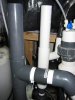
Here's what I came up with (see the white PVC), simple stand pipe for the feed. The water in the pipe stays at the height that the water is set to in the skimmer. The feed comes in about an inch above the water level. This allows the air to blow off, and provides a consistent feed. I think this is working well, but I'll need to give it a bit of time to be sure.

When I ran the drain line directly to the feed of the skimmer, it was mixing in too much air, too far before the pump, so that the pump was moving less water and actually sucking in less air. (yea, it's a strange effect).

 

Attachments

  • feed stand pipe.jpg
    feed stand pipe.jpg
    51.3 KB · Views: 387
John what happens if something gets into your impeller and blocks the skimmer?
 
If the skimmer pump shuts down the water continues to drain as quickly as it fills.

If the hose feeding into the skimmer were to back up, the back up would be covered because the tank it's attached to has two drains both of which can handle the total flow through that tank.

I think the only risk would be if something blocked the inlet to the skimmer plumbing causing the feed line to back up into the stand pipe.

Do you see something I'm missing?
 
Last edited by a moderator:
If the skimmer pump shuts down the water continues to drain as quickly as it fills.

If the hose feeding into the skimmer were to back up, the back up would be covered because the tank it's attached to has two drains both of which can handle the total flow through that tank.

I think the only risk would be if something blocked the inlet to the skimmer plumbing causing the feed line to back up into the stand pipe.

Do you see something I'm missing?

water will take the path of least resistance.
Lets say a clump of algae came loose in your overflow box and blocked the skimmer intake,the path of least resistance would be out the top of your standpipe,in fact it would likely create a syphon drawing more water through this overflow.The water won't neccessarily take the other overflow.
You could fix this by adding some plumbing to the top of the standpipe to a point above your sump.

I will apologize in advance if i am barking up the wrong tree but thats how it looks from what i see in the pic.
 
I think I get what your saying.

If I follow correctly, I should be OK in that scenerio. The duroso on the drain in the tank has a stainer so it could get blocked IN the tank, but nothing big enough to cause a problem should be able to get into the line past the duroso. In that case, the other drain would be able to keep up because the back up would be in that tank, and not in the skimmer feed line.

The skimmer is already raised about a foot above the sump.

I appreciate the input.
 
Kind of a related question:

Jimmy, have you noticed that after the power goes out and turns back on the skimmer overflows the cup a lot?

Just wondering if you had some input?

Maybe I'm feeding the skimmer with MORE than the 300-400 gph recommended? Maybe less? I have the 1" ball valve open about 40%.

Thanks

Guy Duquette
 
My set up doesn't seem to overflow if the power goes out then back on, because the feed is gravity fed off a drain so the feed starts slowly after the power comes back on.

I have seen other people describe the overflow when the power comes back on problem, and it seems to happen mostly or only when the feed is from a pump so that it turns right on full speed insted of ramping up gradually. Somewhere on the reefspecialty forum on RC there was some discussion on this. (IIRC I also saw it reccomeneded there that the orca 200 does best with a slower feed, more like 200 GPH than 300-600 GPH. Better dwell time and less chance of the overflow problem)
 
That makes sense I guess. I remember reading that too. I'll try turning down the feed too. It should fix the problem.

Thanks again Jimmy!
 
Back
Top