
• ******* To read about the changes to the marketplace click here

Dying Wrasse?

waltm

Non-member
Friday afternoon we picked up a Golden Wrasse (Halichoeres chrysus) from a lfs. Similar to the one pictured here http://www.fishbase.org/Photos/PicturesSummary.cfm?ID=4855&what=species

After a 2 hour drip acclimation it was placed into a 65g tank, lights were out by then and the only other fish, 2 black ocellaris, were already sleeping for the night.

Saturday morning he was still buried in the sand with just his mouth poking out when the lights were turned on. He seemed to be doing fine all day, swimming around hunting for food on the rocks and bottom, eating brine along with the clowns etc. The clowns would swim near him once in a while but were not picking on him that I could see.


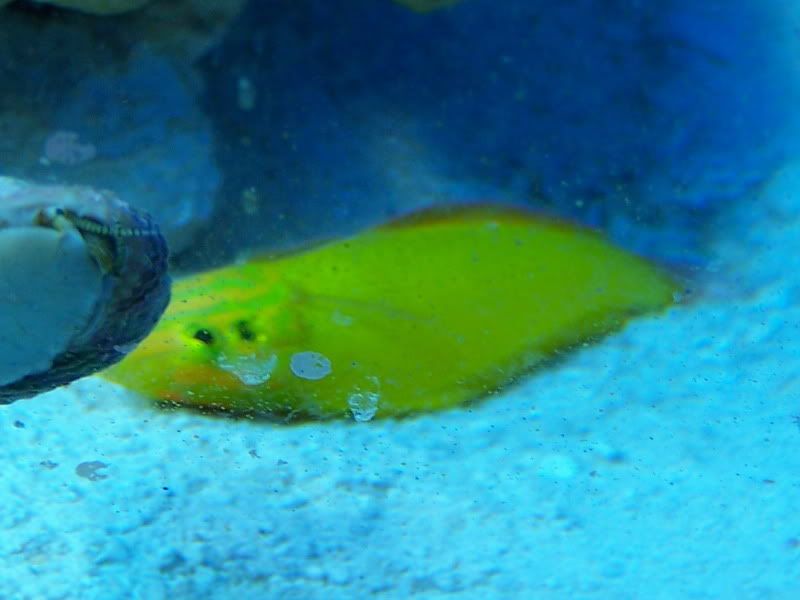
This was him Saturday afternoon.
GWRASSE1_SMALL.jpg


This morning he wasn't swimming around and when we looked for him he was found in the back corner of the tank, on his back, breathing heavy just sort of floating in the current.
GWRASSE2_SMALL.jpg


Is this a stress reaction? Is he dying? Is there any chance he will perk up before the 48 hour guarantee period from the lfs is up at 7:00 pm?

Any insight is greatly appreciated

Thanks
Wally
 
Doesn't look good, Wally.
I'd be surprised if the fish pulled through.
 
Can you describe your acclimation process? I have had a problem doing long drip acclimations before if it is done in the bag that the fish came in. If you leave it in the bag, the top of the bag is normally collapsed after it is opened. This results in essentially no surface area at the wwater surface and if you use a long acclimation like you did the fish will be deprived of oxygen and can die. Best to do a very short acclimation if you are using the bag the =fish came in otherwise use a bucket with an airstone to keep oxygen levels up.
 
well, the fish stopped breathing about a half hour after I posted that.

Yes, it was done in the bag. For smaller things I float a measuring cup in the sump and drip into that, every 15 minutes I pull some water out with a baster to keep the level about the same. For larger things I have been using the bag, clipped on to the edge of the sump so it doesn't fall in all the way but I'll try in something ridged that can't collapse. It just seemed odd that it was fine for a whole day and took a turn for the worst overnight.

I brought a sample of water to the LFS when I brought back the fish and they confirmed my test results, except for ph which they were out of, so at least I know its not water related.
 
Last edited:
2 hour acclimation seems long to me. I usually acclimate for 20-30 minutes at best. Not suggesting this is necessarily the issue, I think fish that are not properly acclimated don't do well from the get go. If your fish was eating and swimming actively, it is probably some other factor.

For what it is worth, I have had difficulty with the yellow Halicores in the past. I've tried and lost 3 fish in about an 18 month period. Sometimes they do well for 6-8 weeks before dissapearing or turning up dead. Not sure why, I have a varierty of other wrasses that are healthy. They might just be sensitive or poor shippers.
 
waltm said:
well, the fish stopped breathing about a half hour after I posted that.

Yes, it was done in the bag. For smaller things I float a measuring cup in the sump and drip into that, every 15 minutes I pull some water out with a baster to keep the level about the same. For larger things I have been using the bag, clipped on to the edge of the sump so it doesn't fall in all the way but I'll try in something ridged that can't collapse. It just seemed odd that it was fine for a whole day and took a turn for the worst overnight.
This is the exact same thing that happened with my first male red margin wrasse. I was told that it was due to lack of disolved O2 since there is no surface area for gas exchange like I mentioned in my earlier post. If you are going to use the bag I would suggest no longer that 15 minutes.

Sorry you lost it, it was a nice lookin fish.
 
Any suggestions on what to use if I want to acclimate right in the tank? I have always used the LFS bag and just floated it but what Mike says makes sense.
 
I know I will probably get flamed for this, but with fish, I have always had the best luck doing the following: I add a few cups of my tank water to the bag the fish comes in, float it in the tank for about 15-20 minutes, then scoop the fish out and put it right in the tank. Maybe I've been lucky, but I've never lost a fish from this (unless you count one a Clarkki ate).
 
For what it is worth, I acclimate the way Steve does. I usually float the bag in my sponge tank for about 10 minutes, then cut the top open and add a few cups of my tank water. wait 5 minutes and either do it again, or pour out some of the water if the bag is full and add a few more cups of y own. Another 5 minutes and I pour most of the water out and scoop the fish with my bare hand into the tank.

Total acclimation time 20 minutes top.

Steve, If you get flamed, I'll share the anguish with you.:D
 
seahorse1 said:
Any suggestions on what to use if I want to acclimate right in the tank? I have always used the LFS bag and just floated it but what Mike says makes sense.
I would either go the route that Steve and Jacqur do or if acclimating for longer (I would never do more than 30-60 minutes, depending how far off the salinities are) then usae a 5 gallon bucket with the drip hose out of the water so it breake the waters surface or I use a air pump to make sure it stays oxygenated. Ideally all fish should be going into quarantine, but this doesn't always make sense. This info is based on research after loosing an expensive fish from acclimaing as described in the first post and based on a conversation with the Aquarium Gallery staff.
 
Thanks for all the info! I picked up the replacement fish yesterday and did a shorter acclimation as suggested.

Unfortunately they only had 2 of these fish left, they had over 10 Friday night, and they don't look as nice. They are solid yellow with several black spots on the dorsal fin and no marking on the face like the previous one. My wife really liked the coloring of the fist one and is just OK with the second. Would this be a geographical difference or an adult / juvenile thing?
 
Juvenile, adult thing; also a gender thing.
 
This is where I usually get confused so I apologize if this doesn't make sense.


I believe most fish in the wrasse family can change sex as they mature. From females and immature males to terminal phase males. Would the Halichoeres Chrysus be one of these? Assuming I have either a female or juvenile male, since it has the extra dorsal fin spots, will it morph into a male over time since it is the only one in the tank?

Please feel free to correct any misconceptions I may have or point me to an on line wrasse resource.

Thanks again!
 
I think you're correct, and I think it will morph into a male.
Could be the default is female, though. I'm not 100% sure on that.
 
All wrasses can become males. In some species the dominant female will become the next male when a spot is vacant. In some species there are born males as well as female derived males. It didn't specify in the book that I referenced for that species. With most wrasses they need to be kept in pairs or harems to bring out their nuptial colors.

A good reference is Fairy and Rainbow Wrasses and their relatives by Rudie Kuiter.
 
I have a tupperware conatiner about 7" x 12" long that I use for acclimation, depending upon the fish. I also have a 10g that I can use
I do the same as Steve for the most part, add water - generally to bring it to 30% tank water
Set a timer for 10 minutes, add water so now it is 50% tank water
10 minutes later bring it up to 75% tank water
10 minutes later drain out 1/2 & refill with 1/2 tank water - this should bring it to around 87% tank water
10 minutes later in the tank

So usually around 40 minutes
Sometime smore, sometimes less
 
All wrasses can become males. In some species the dominant female will become the next male when a spot is vacant. In some species there are born males as well as female derived males. It didn't specify in the book that I referenced for that species. With most wrasses they need to be kept in pairs or harems to bring out their nuptial colors.

A good reference is Fairy and Rainbow Wrasses and their relatives by Rudie Kuiter.

Hes right.

I'm pretty sure that halichoeres as a genus has both initial phase, and terminal phase males. IE some fish are born as males, some as females. Large females can turn into males, but usually will not get as colorful as initial phase males. Nothing changes back to female.
 
I know I will probably get flamed for this, but with fish, I have always had the best luck doing the following: I add a few cups of my tank water to the bag the fish comes in, float it in the tank for about 15-20 minutes, then scoop the fish out and put it right in the tank. Maybe I've been lucky, but I've never lost a fish from this (unless you count one a Clarkki ate).

Not for Nothing Steve but I've done the same thing with an excellent success rate.

Maybe there was something wrong with the animal for the start. Cyanide caught maybe? You just never know.
 
Not sure if makes a difference but do you think that it may be more important to follow a more stringent drip acclimation protocol for a speciman that was shipped to you versus one that was picked up at the LFS and brought right home.
 
Well, I'm now 2 for 2 with this species of fish. The replacement was an exact replay of the first one, introduced into the tank, looked fine the next day, eating frozen mysis. Didn't show up on day 3, I thought he might just be hiding in the sand. Found his tail sticking out of the sand the morning of day 4. Found him dead after work.

As much as I like the looks of this fish and what they bring to the tank, eating flatworms and all, I'm thinking I should give up on them. They were both from the same shipment so I guess there is a slight possibility that there was something wrong from the get go such as cyanide poisoning but I didn't think that was even used any more.

I'm not looking forward to breaking the news to my wife.... again....
 
Back
Top