
• ******* To read about the changes to the marketplace click here

Optimum Flow Rates

JCheung

Newbish
Ok I'm still a little confused on flow rates, what is the optimum flow rates for a main tank? (5x size) gallons per hour? So i have a 90 gallon tank and i just ordered a koralia 4 should that be enough?

Ok also was is the optimum flow rate for say a 10 gallon sump tank filled with live rock?

How about a 10 gallon sump tank filled with sand?

How about a 20 gallon tank with a large skimmer?

The plan is now to have overflow to a tank on the side with the skimmer, this exhausts to a 10 gallon tank under the stand filled with live rock, which drains into another 10 gallon tank with a deep sand bed, which that in turn drains to another 20 gallon tank on the other side of the stand, which has a pump that goes into a refugium that is above the main tank, and that drains into the main to complete the cycle. I'm trying to figure out the proper flow rates for each stage of this setup so i can drill holes, or put overflows accordingly.

I'll upload a MS paint picture of the theoretical setup after i draw it.
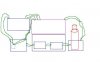
 
Picture

Uhh Picture i hope you guys catch my drift. I seriously need a camera.
 

Attachments

  • Tank setup.JPG
    Tank setup.JPG
    14.5 KB · Views: 262
Anyone know, i'm just trying to find out what would be the best setup for someone in my situation.
 
It all really depends on what you want to keep in your tank and how you want your sump to work. I'm probably going to run about 500GPH through my sump and about another 700GPH in my display . So that is about 1200GPH turnover in a 70 gallon display. 5x turnover isn't a whole lot.
 
Oh yeah...Also, IMO, you have way too many tanks connected together. IMO, your asking for a flood with that configuration. In your plan, what will happen if a pump fails or you lose syphon? Have you taken that into consideration and figured out what kind of affect it will have?
 
i have 700 from my sump, and 3840 in the tank, its a 75gallon i know its a bit much
 
What type of corals do you plan to keep. That will determine the flow rate in the display.

What skimmer are you running and what is the pump that it uses? How much water does it process in gph? That will give a good estimate of water through the skimmer section. You can keep this flow through the sand bed tank and into the sump. This will be based on the skimmer, try to push a little more water than the skimmer processes.

Is the 90 reef ready or are you going to be installing a overflow? Either way it will most likely handle about 600gph unless you have more than 1 drain or larger than 1".

Again this will be based on the skimmer and then on how much gph the display can drain but I would use a 500-600pgh return pump (if the skimmer doesn't pump much more than that, and the display can drain that fast) And put about 1/3 of it into the refugium before it dumps back into the display.

The rest of the flow in the display would be achieved through powerheads like the Koralia or a closed loop or both. Again this will depend on what type of corals you plan to keep but I would say roughly 10-20x for softies and lps and 20-40x for SPS. I feel a few smaller pumps is better than one big one. The goal here is to get random wide flow patterns in the tank. Hard to achieve with a single powerhead.

Hope this helps and you should get better responses with more detailed descriptions of what you want to keep.
 
Oh yeah...Also, IMO, you have way too many tanks connected together. IMO, your asking for a flood with that configuration. In your plan, what will happen if a pump fails or you lose syphon? Have you taken that into consideration and figured out what kind of affect it will have?

I agree if you do this configuration, the 4 tanks on the bottom need to be drilled and have bulheads directly connecting them together to eliminate the risk of flooding. I would not trust that many syphons in one system.
 
Yes i was planning on drilling the tanks and connecting them together through like a straight tube with a valve in the middle. The tank is not yet reef ready i am thinking of getting a HOB overflow unless i can drill the tank when it is full.

I haven't figured which skimmer to get yet, i was thinking of getting a skimmer rated between 200 to 300 gallons.

As for corals i'm thinking more along the lines of Softies and LPS's.
The reason i'm asking the flow questions is because i heard the refugium should have lower flow rates and i wasn't sure if the other parts, sand, rock, sump, skimmers needed low or high flow rates. And i will have a koralia 4 which is advertised as 1200GPH so i want to know how much more should i have.
And it looks like according to MikeG i should aim for 500 to 600 GPH on top of the koralia 4. And having the refugium have 200 GPH. So i assume the live rock, skimmer, DSB and sump should have 500 to 600 GPH also.
 
So i assume the live rock, skimmer, DSB and sump should have 500 to 600 GPH also.
Not necessarily...The skimmer flow rate is completely based on what type of skimmer you have (should say in the manual). The sump flow rate can really be whatever you want. IMO, there is no need for the tank filled with Live Rock or the separate DSB. It looks like you are trying to just use a bunch of tanks you have lying around instead of getting one tank that will do what you need. All you need is one tank to do what you want.
 
I run 3600 GPH through my 75 gallon. The majority of the flow is from powerheads. I like my sump flow to be medium to slow.
 
It looks like you are trying to just use a bunch of tanks you have lying around instead of getting one tank that will do what you need. All you need is one tank to do what you want.

That is kind of what i am trying to acheive, but i also have to work within the confins that i already placed the live rock, sand, and water into the main tank and it is already on the stand, so i can only fit 10 gallon tanks into the bottom of the stand. I was going for 20's or larger but they don't fit through the front. Originally i was just going to go single sump, and single refugium, but that waws shot down when i found out it would get micro bubbles into the main tank, so i figured a very long chain like this would be able to get rid of the bubbles before it entered the final stages. Also i have the tank setup on the only flat long wall in my apartment, this also holds my 55 gallon turtle tank so the only space i have left on the wall is just enough for my old 20 long. (Yes my apartment was designed kind of stupidly with rounded walls.)
 
The 20 gallon tank on the bottom left can also be used as a frag tank if you wanted.

I actually like the idea of a seperate tank for the deep sand bed and am planning the same for my current tank, just havn't gotton to it yet. It makes it very easy to take the tank of line and replace the sand bed every couple years rather than having to eventually tear down the tank to replace it.
 
I don't buy the argument you will have less micro bubbles with all those tanks than a single sump/refugium would. Just feeding those tanks will create bubbles.

It definitely looks like a flood hazard, and I question the ability of a pump to pull through all those tanks. I am guessing there would be some performance issues....

I know people running 29 gallon sumps on 90 gal tanks with no problem...
 
I don't buy the argument you will have less micro bubbles with all those tanks than a single sump/refugium would. Just feeding those tanks will create bubbles.

It definitely looks like a flood hazard, and I question the ability of a pump to pull through all those tanks. I am guessing there would be some performance issues....

I know people running 29 gallon sumps on 90 gal tanks with no problem...
Lots of stores run tanks that are linked together like this no problem. As long as the bulkheads are oversized I don't see how it can be a flood risk unless the tank cracks? Can you elaborate on what your thinking? I would put strainers on all the bulkheads so they can't get clogged with a rogue snail or something.

Also it you keep the bulkheads halfway down in the water column, then it definately should help to eliminate bubbles as they will rise to the surface and break as they travel. If it is not enough, 1 baffle placed just after a bulkhead at the beginning of one of the tanks will force the bubbles to the surface and help get rid of them.

I see nothing wrong with this set up other than using more space than needed and making things more complex than needed. It is functional and I just don't see where the flood potential is :confused: If anything I think it is safer in a poweroutage due to the shear surface area of the bottom row of tanks. The vertical change in a power outage will be much less on this than one large taller tank.

The one key here is that all of the tabnks on the bottom need to be at the same height (the tops are the same) to maximize water storage. In the illistration above, the water can only go as high as the 2 10 gallon tanks in the middle. The outer 2 could go higher but then the 10 gallons will overflow. the water level can only go as high as the top of the lowest tank. This is important in a power outage!
 
Last edited:
I don't buy the argument you will have less micro bubbles with all those tanks than a single sump/refugium would. Just feeding those tanks will create bubbles.

It definitely looks like a flood hazard, and I question the ability of a pump to pull through all those tanks. I am guessing there would be some performance issues....

I know people running 29 gallon sumps on 90 gal tanks with no problem...

Err, i didn't mean that the micro bubbles was the only reason i was doing this, but if i only had a single 20 gallon tank that just had the skimmer and return i would probably have more bubbles than if i routed it around it would give it enough time to surface or stick to something else before going through the return pipes.
Also i have kind of thought about the performance issues and i think if i have progrssively larget flow rates as i go down the line it should handle it well enough i think. I was actually hoping to connect the two 10 gallon tanks with a single bulkhead but decided against it.
And yes the modularity of the design i thought would be a big plus. Being able to reroute the flows and clean tanks without much interruption.
 
I just set up a 90 gallon and have about 750 GPH going to my sump and then have 2 Koralia 4s...one on each end of the tank. IMO it's perfect. Not too much flow as the Koralia's have a pretty wide flow distribution....and depending on where you place them and your rockwork you can create slower flow areas.
 
I have a 65 gallon, use a bluline 40 for return direct shot no bends up the overflow, and 2 koralia 4's so roughly 700gph through sump and 3100 gph flow in display.

The sump however has an additional 1000gph circulated flow, skimmer with a mag7 and uv sterlizer with a maxijet 1200. So 1700gph circulation in sump.

Yes the water is crystal clear. I can take a pic from above and you would think it was fake corals in an empty tank.

However everything boils down to what you plan on keeping. I tend to keep SPS that like flow. Seahorses would however not like my tank..................
 
Last edited:
Hmm ok to give less of a chance for flooding they should all have relatively the same heights so the bottom tanks should be 20 high, 15 high x 2 and a 29 gallon tank. so that would essentially make it a 79 gallon sump with a 20 long refugium and a 90 main.
 
Hmm ok to give less of a chance for flooding they should all have relatively the same heights so the bottom tanks should be 20 high, 15 high x 2 and a 29 gallon tank. so that would essentially make it a 79 gallon sump with a 20 long refugium and a 90 main.
They don't have to be the same height as far as tank dimensions, just raise the shorter tanks on small 2x4 frames or something similar to basically make them all the same height. You can use what you have without any issues.
 
Back
Top