Major plumbing progress: BashSea sump, display drains, return stacks, and frag tank mockup
A lot moved forward on Bob’s Reliability Reef this weekend. Still dry, still not rushing water into the system, but the plumbing is finally starting to look like an actual fish room instead of a collection of expensive white and gray spaghetti.
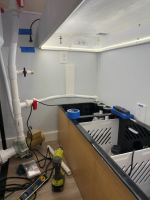
Big decision: the BashSea sump is now the committed sump and is in final position in the fish room. The stock Waterbox sump is out of the plan and in storage /
listed for sale (on
BRS). The display drains are now routed into chamber 1 of the BashSea.
Current display drain setup:
- 1” main drain
- 1” open channel
- 1.5” emergency drain
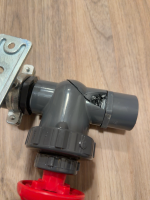
The main tank-to-sump home runs are welded, and the return side made a big leap too. Final return plan is two Varios 6 pumps, each with its own check valve and true-union ball valve stack so either pump can be serviced or cleaned independently without taking down the whole return system.
The service portal through the wall is doing exactly what I hoped it would do: large enough for real hand access, unions, bulkheads, drain routing, and future regret-reduction. The PVC trim / pass-through sleeve approach is also helping make the wall penetrations look intentional instead of like I lost a fight with drywall.
Frag tank status
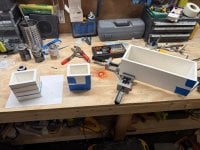
The frag tank is wall-secured, drilled, and bulkheads are installed. The frag plumbing is mocked up but not welded yet.
Frag tank drain plan is Herbie style:
- 1” full siphon with gate valve behind the frag tank
- 1” emergency drain
- Both will run around the outer fish-room wall and drain back into chamber 1 of the BashSea with the main display drains
There is plenty of vertical fall available, so the design risk is less “can gravity work?” and more “can I make this quiet, supported, serviceable, and not annoying to tune later?”
Varios 8 utility loop
The Varios 8 will live in the BashSea sump and run the utility/service side of the system.
Planned branch order:
- UV loop — 1”
- Frag feed — 3/4”
- Chiller feed — 3/4”
- Overhead service drain — 1”
That
overhead drain is intentional. I’m trying to preserve future optionality for easier service and water changes. The current overhead waste line already has a 1” drain from the 110g mixing tank and runs up/over to a remote 2” receiver about 25 feet away. The future Varios 8 service drain will share that path.
Continuous water change waste is likely future-state, probably 1/4” polyethylene tubing, but that is probably 6–12 months out.
I’m leaning toward a simple manual high-point vent / vacuum break on the overhead drain rather than trying to make an air admittance valve do aquarium plumbing things it was not meant to do.
Support and serviceability
The return stacks have supports now, but the Varios 8 loop and the long frag tank drain run will need more support before I call anything final. I have split rings and standoffs where clearance allows, and plastic pipe hanger strap available for tight spots.
The aesthetic goal is still: visible, supported, labeled, serviceable plumbing. Future Bob should be able to understand what Past Bob did without needing a séance.
Definition of done for next weekend
For the July 4th weekend, I’m not aiming for a full wet test. The realistic goal is:
- Weld the Varios 8 utility loop
- Weld the frag tank Herbie drains back to the BashSea
- Add supports and labels
- Only do RODI-only testing if time, energy, and common sense allow
Also, in classic reef-build fashion, I managed to earn 3 stitches in my thumb during the weekend’s work.
Somehow I’ve made it to 41 without getting stitches.
I am taking the hint from the universe: no saltwater testing yet, no hero mode, and no “just one more cut” nonsense.