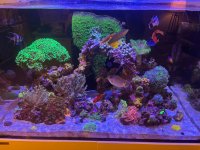
Good evening fellow Boston Reefers. Looking for any advice on what may be going on in my tank. I, within the last month or so, got a Red Sea doser, which has allowed me to get a stable alkalinity (vs adding Seachem Fusion 1/2 every other day).
The only thing slightly different from them is my alk is been in the 9.5-10 range vs before when it was in the 7.5-8.5 range.
Current parameters tonight which are pretty similar to last week:
Alk-9.5
Ph - 8.2-8.3
Cal - 440-450
Mg - 1380-1410
Nitrate -10
Phosphate 0.10
Using Fritz RPm (which the guy I purchased
My rank from 2 years ago used too).
Photo attached of a plate coral I have had for a year or more that I just noticed tonight that is receding a lot. It did get some sand on it from watchman gobies recently but I didn’t think enough to cause it. Everything else looks to be doing great including Gino’s, hammers, mushrooms, zoas (some are struggling a bit near the bottom I think possibly due to some dynos or diatoms but have a UV now, and higher light ones are doing great on the top area of the tank.
I have had a few occasional hammer / frogspawn bailouts on one of the bigger colonies in the last month as well with everything else looking great, which has added to my frustration.
I do have a marinepure block in the sump which I have had since about when I moved the tank (from where it was purchased). Could this be causing an issue? I have read so many pros and cons on it. Could I just remove it if I have probably 50-60 lbs of live rock in the tank and sand as well. Will it cause a cycle or anything?
Just looking for thoughts. This is a water box 100.3
I did just order an ICP test for the heck of it but don’t know how believable result is that will be.

The only thing slightly different from them is my alk is been in the 9.5-10 range vs before when it was in the 7.5-8.5 range.
Current parameters tonight which are pretty similar to last week:
Alk-9.5
Ph - 8.2-8.3
Cal - 440-450
Mg - 1380-1410
Nitrate -10
Phosphate 0.10
Using Fritz RPm (which the guy I purchased
My rank from 2 years ago used too).
Photo attached of a plate coral I have had for a year or more that I just noticed tonight that is receding a lot. It did get some sand on it from watchman gobies recently but I didn’t think enough to cause it. Everything else looks to be doing great including Gino’s, hammers, mushrooms, zoas (some are struggling a bit near the bottom I think possibly due to some dynos or diatoms but have a UV now, and higher light ones are doing great on the top area of the tank.
I have had a few occasional hammer / frogspawn bailouts on one of the bigger colonies in the last month as well with everything else looking great, which has added to my frustration.
I do have a marinepure block in the sump which I have had since about when I moved the tank (from where it was purchased). Could this be causing an issue? I have read so many pros and cons on it. Could I just remove it if I have probably 50-60 lbs of live rock in the tank and sand as well. Will it cause a cycle or anything?
Just looking for thoughts. This is a water box 100.3
I did just order an ICP test for the heck of it but don’t know how believable result is that will be.