• ******* To read about the changes to the marketplace click here

Definition of Reef Insanity Build - Dave's 120G Tech Tank V4

daves-reef

Well-Known Member
BRS Member
“The definition of insanity is doing the same thing over and over again and expecting different results.”
Breaking the Cycle of Failure – New Sump, Better Results TBD

For me, it’s been the insanity of trying to maintain my 120-gallon reef tank with a basement 100G+ sump and refugium. Four years ago, a coral crash—sparked by the third external return pump failure (and without an on-hand spare)—forced me into a fish-only setup. Thankfully, all my fish survived. I replaced the pump and shifted to feeding the fish and cleaning algae.

Then, the latest pump failure at the start of 2025 pushed me to the brink. I seriously considered calling it quits after more than 30 years of reefing. For now, my fish are safely housed in a temporary home elsewhere.

This build thread will document my fourth attempt in my current home. It will force a go/no-go decision: Do I bring my fish back, maybe even reintroduce coral, or finally hang up my salt buckets for good? The revamped build will use my existing Oceanic Tech 120G display—with its three-sided Starfire glass—and feature Trigger Systems' Emerald 34 sump positioned under the display in the stand. It will include an internal return pump (no more external pump failures and leaking crises) with all electrical components and support equipment neatly contained under the sump—a space challenge extraordinaire.

I anticipate that I’ll need to devise an entirely new approach to maintenance. I’m also curious whether the new configuration will be quiet enough for the TV room. Can it be both practical, sustainable, and peaceful enough to keep me in the hobby?

Stay tuned for more details on the build—or look for the “getting out” post if I just give up.

The V3 build Oceanic 120 Tech Tank Closet Basement Sump Reboot
What once was and why it is probably insane to try again. Dave's-Reef V3, circa 2020, before the pump failure:
To view this content we will need your consent to set third party cookies.
For more detailed information, see our cookies page.
 
Last edited:
I run my setup in my tv room and it is quiet. I use the ecotech vectra I'm sure you will be successful with your setup. Vouching for your success
 
My tank is in the living room, I use a Jebao sinewave and its still quiet after 4-5 years of hard abuse, and severe neglect
 
Installing the Sump: This is Pure Insanity
I wasn’t even sure if it would fit, let alone function. This might be the first step toward calling it quits. Can it hold and circulate water? TBD if this will work at all.

Modern reef tank stands must be taller. My old Oceanic oak stand has just under 25" of vertical clearance. The sump itself is 15" tall, leaving a razor-thin 10 inches for both 1” overflow drains and connections. Factor in the built-in sump drain pipes, and the available space is nearly nonexistent. There’s zero wiggle room for sump placement or drain lines.

To maintain a nearly silent Herbie-style overflow (which worked flawlessly in my basement setup), I had no choice but to use two elbows per drain—forming an upside-down, backward ‘S’ shape.
Herbie Overflow Plumbing Guide
Will the extra bends cause noise or restrict flow too much? Adjustments might be limited, but the gate valve on the siphon drain should help.

Thankfully, the return line is soft plumbed, allowing for future flexibility—like swapping pumps or even running dual returns. My Coral Box DC pump is rated around 800 GPH, and with only a 3x turnover goal, it could work—but the real test is how it handles extra elbows and head pressure.

Has anyone else dealt with a tight Herbie overflow setup?
How did extra elbows impact flow and noise? Any fine-tuning tricks?

Rather than opting for a Bean Animal setup, I’m relying on a float switch safety net:
If the primary drain slows, the secondary kicks in and a Neptune Apex alarm alert is triggered.
If the tank water level climbs too high, a second switch will shut down the return pump automatically.
This system worked flawlessly in my old basement setup, so I’m trusting it again.

kuxwD1u.jpg

4baRPxz.jpg
 
Installing the Sump: This is Pure Insanity
I wasn’t even sure if it would fit, let alone function. This might be the first step toward calling it quits. Can it hold and circulate water? TBD if this will work at all.

Modern reef tank stands must be taller. My old Oceanic oak stand has just under 25" of vertical clearance. The sump itself is 15" tall, leaving a razor-thin 10 inches for both 1” overflow drains and connections. Factor in the built-in sump drain pipes, and the available space is nearly nonexistent. There’s zero wiggle room for sump placement or drain lines.

To maintain a nearly silent Herbie-style overflow (which worked flawlessly in my basement setup), I had no choice but to use two elbows per drain—forming an upside-down, backward ‘S’ shape.
Herbie Overflow Plumbing Guide
Will the extra bends cause noise or restrict flow too much? Adjustments might be limited, but the gate valve on the siphon drain should help.

Thankfully, the return line is soft plumbed, allowing for future flexibility—like swapping pumps or even running dual returns. My Coral Box DC pump is rated around 800 GPH, and with only a 3x turnover goal, it could work—but the real test is how it handles extra elbows and head pressure.

Has anyone else dealt with a tight Herbie overflow setup?
How did extra elbows impact flow and noise? Any fine-tuning tricks?

Rather than opting for a Bean Animal setup, I’m relying on a float switch safety net:
If the primary drain slows, the secondary kicks in and a Neptune Apex alarm alert is triggered.
If the tank water level climbs too high, a second switch will shut down the return pump automatically.
This system worked flawlessly in my old basement setup, so I’m trusting it again.

kuxwD1u.jpg

4baRPxz.jpg
because you do not have a lot of vertical piping I would think it should be pretty quiet. What kind of skimmer are you planning on running. Yes that stand it tight. most newer stands are 32-35” tall. Looks good so far though.
 
because you do not have a lot of vertical piping I would think it should be pretty quiet. What kind of skimmer are you planning on running. Yes that stand it tight. most newer stands are 32-35” tall. Looks good so far though.
Funny how this started as a “low-cost gamble” with a free sump, borrowed pump, and my existing DC skimmer—just to see if reefing was still worth it. I should’ve known better… this is turning into more of a gamble than keno at the bar.

The reefing cash drain is inevitable. First, I had to buy a used modern sump that actually fits in the stand. Then, surprise—the skimmer was too tall. So, I picked up a used Eshopps X-220 from a fellow reefer (thanks, Will!).

Also planning to grab a silicone mat (like this one) to cut for under the skimmer—because why not add one more thing to the list? Definitely not the last… just need to get to the “filled-with-water” test.

Cocaine was big in the ’90s, but not for me. Instead, I had a saltwater fish habit—and honestly, doing drugs would have been cheaper.
 
Funny how this started as a “low-cost gamble” with a free sump, borrowed pump, and my existing DC skimmer—just to see if reefing was still worth it. I should’ve known better… this is turning into more of a gamble than keno at the bar.

The reefing cash drain is inevitable. First, I had to buy a used modern sump that actually fits in the stand. Then, surprise—the skimmer was too tall. So, I picked up a used Eshopps X-220 from a fellow reefer (thanks, Will!).

Also planning to grab a silicone mat (like this one) to cut for under the skimmer—because why not add one more thing to the list? Definitely not the last… just need to get to the “filled-with-water” test.

Cocaine was big in the ’90s, but not for me. Instead, I had a saltwater fish habit—and honestly, doing drugs would have been cheaper.
haha sorry to hear that. Drugs truly are probably cheaper than this hobby when making changes. Looking forward to see it back up and running. Keep the faith. I am upgrading to my 170 and 2nd guess every move and equipment with use the existing or upgrade while it is not running yet.
 
Funny how this started as a “low-cost gamble” with a free sump, borrowed pump, and my existing DC skimmer—just to see if reefing was still worth it. I should’ve known better… this is turning into more of a gamble than keno at the bar.

The reefing cash drain is inevitable. First, I had to buy a used modern sump that actually fits in the stand. Then, surprise—the skimmer was too tall. So, I picked up a used Eshopps X-220 from a fellow reefer (thanks, Will!).

Also planning to grab a silicone mat (like this one) to cut for under the skimmer—because why not add one more thing to the list? Definitely not the last… just need to get to the “filled-with-water” test.
I used to always cheap out and buy used items which inevitably always seemed to bite me in the a** and caused me many issues that made me rethink staying in the hobby. Just doing my stand upgrade I've had to change so much and it's made me question many things such as why did I build the stand to accommodate a 48"x24" footprint which will inevitably cause me to buy a bigger tank and then go through the whole process again of moving everything around!

For once in my reefing life I wish I had a proper budget and just did things right the first time! I am sure it would probably end up cheaper in the long run too!
Cocaine was big in the ’90s, but not for me. Instead, I had a saltwater fish habit—and honestly, doing drugs would have been cheaper.
haha sorry to hear that. Drugs truly are probably cheaper than this hobby when making changes.

Cheaper yes but not as much fun and depending on the drug sort of illegal! I still remember hearing stories about when the club started out and venues would require us to hire a Police detail until they looked at the website and saw that we were just a bunch of saltwater reefing nerds and not potheads!!!
 

Power Cable Management: The Least Insane Part of This Build (Hopefully)

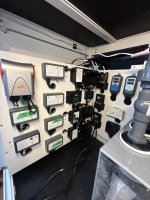
Working on power cable management for the Neptune Apex and all its power cords, bricks, and cables feels like the least insane part of this build—so far. Combining everything that used to live in the basement with the display tank setup is a tight fit, but at least it’s organized. Before, cords were just piled on a shelf under the tank. Now, they’re tidy… but troubleshooting could be a nightmare. I’m trying to leave enough slack to pull things out for maintenance—fingers crossed.

Almost ready for the freshwater test (the first real “keep or quit” decision point). My plan is to use RO water first (and add salt later if all’s good) rather than mix saltwater and risk needing to drain it all. Should’ve known better than to be optimistic.

The glass isn’t half empty—sometimes it’s poisoned water.

After swapping out ancient RO filters, fixing loose hoses and leaks, and replacing the TDS meter battery, I got high TDS readings from the membrane output—even with all new filters, including the membrane. Turns out the auto shutoff was bad, leaking at the seam. Of course. Because why would anything reef-related go smoothly for me? A new one is on order.

This is my first under-stand sump build, and I’m definitely not used to the limited space. At my old house, the tank had a behind-the-wall sump, and even version 1 of this display had a similar setup when it was in the basement. Now, with the basement pipes gone (though the access hole remains), I’m considering using that basement access for an ATO (Automatic Top-Off). With the tight space under the tank and the hassle of refilling a reservoir, an under-stand ATO might not be feasible. Otherwise, I’ll be manually topping off water like it’s 1999.

Would a two-story ATO—and possibly more—be the same old insanity or just a new version of madness? Is this doing the same thing over and over or just the same thing... but different?

Cable and power management using stuff I had on hand, plus a few new Velcro cable ties.
WOxoK1p.jpg

YVKWx6v.jpg

FiOQugS.jpg
 

Power Cable Management: The Least Insane Part of This Build (Hopefully)

Working on power cable management for the Neptune Apex and all its power cords, bricks, and cables feels like the least insane part of this build—so far. Combining everything that used to live in the basement with the display tank setup is a tight fit, but at least it’s organized. Before, cords were just piled on a shelf under the tank. Now, they’re tidy… but troubleshooting could be a nightmare. I’m trying to leave enough slack to pull things out for maintenance—fingers crossed.

Almost ready for the freshwater test (the first real “keep or quit” decision point). My plan is to use RO water first (and add salt later if all’s good) rather than mix saltwater and risk needing to drain it all. Should’ve known better than to be optimistic.

The glass isn’t half empty—sometimes it’s poisoned water.

After swapping out ancient RO filters, fixing loose hoses and leaks, and replacing the TDS meter battery, I got high TDS readings from the membrane output—even with all new filters, including the membrane. Turns out the auto shutoff was bad, leaking at the seam. Of course. Because why would anything reef-related go smoothly for me? A new one is on order.

This is my first under-stand sump build, and I’m definitely not used to the limited space. At my old house, the tank had a behind-the-wall sump, and even version 1 of this display had a similar setup when it was in the basement. Now, with the basement pipes gone (though the access hole remains), I’m considering using that basement access for an ATO (Automatic Top-Off). With the tight space under the tank and the hassle of refilling a reservoir, an under-stand ATO might not be feasible. Otherwise, I’ll be manually topping off water like it’s 1999.

Would a two-story ATO—and possibly more—be the same old insanity or just a new version of madness? Is this doing the same thing over and over or just the same thing... but different?

Cable and power management using stuff I had on hand, plus a few new Velcro cable ties.
WOxoK1p.jpg

YVKWx6v.jpg

FiOQugS.jpg
looks good I feel the pain
IMG_0922.jpeg
 
Freshwater Test Using R.O. Water Underway

Started by filling the overflow to check the bulkheads—no leaks there. It’s going to be a slow fill at 75 GPD. I let it run all day yesterday but didn’t feel comfortable leaving it running overnight. My initial plan was to fill the display tank first, leaving the sump dry. Then I read about Corey’s unfortunate sump issue in his build thread:
Corey's IM 170 EXT Build

His experience convinced me to fill the sump early to check for leaks. I just filled the sump now using the overflow. The first leak is a drip from the gate valve stem, which might be fixed by tightening the packing nut. I suspect the issue could be from the valve sitting dry for weeks. Since it’s dripping directly into the sump, it’s not an immediate problem. I’ll need the tank fully filled for a complete test, but I might run the pump briefly just to check the return line.

LseQcmI.jpg
 
“Does My Sump Theory Hold Water?”

To quote My Cousin Vinny, “Does my sump theory hold water?” Yes. Yes, it does. The tank and sump are holding water, and after a couple of days—no leaks. I’ve added salt and adjusted the drain gate valve. It’s a tiny bit louder than before, but not by much.

Then I started the skimmer—an Eshopps Axium X-220, picked up just to test whether keeping the tank was feasible. And that’s where the transition to an all-under-tank setup hits a major issue: the hum. Even with a silicone mat underneath, it’s loud enough to permeate the room. If I decide to keep it, I may need to invest in a quieter DC skimmer that fits—another space challenge, since most common options won’t. Just like my old basement sump skimmer didn’t.

On the plus side, it’s already pulling out gunk—which, as it turns out, I needed right away.

I’ve never been a fan of the dead fish/shrimp cycle method, but that’s basically where I’m at. I could only clean the overflow so much. When I broke it down, it was covered in green palys and majanos, which I scraped off as best I could. Whatever organic matter remains will take time to break down. I’ll need to grab some rock from the old sump to help kickstart the cycle.

The old display rock was a lost cause—coated in pests and impossible to store without rotting. Thankfully, there’s still plenty of usable rock left in the sump. Next step: sort through it and come up with a new aquascape to cycle the system and break down whatever’s still lingering in the tank.
 

Sand & Rock: Decisions Made​

After weighing the pros and cons of bare bottom vs. sand, I’ve decided to go with a 1-inch layer of CaribSea Special Grade Reef Sand. The responses to my Show Me Your Bare Bottom question were mixed, but in the end, it’s all about trade-offs. Using a sand bed again—am I crazy? Maybe. But the extra surface area for beneficial bacteria helps offset my planned lower rock volume, and the biodiversity boost—plus my personal aesthetic preference—tipped the scale. Let’s just hope the sand doesn’t turn into a maintenance nightmare I won’t keep up with. In a mixed reef, that seems like the only real downside, unlike a bare bottom SPS-dominant setup where high flow is king.

For the display rockwork, I repurposed leftover rock from the basement sump and attempted a limited-space-inspired aquascape. Thick CA glue secured the base, with pulverized reef rock dust and ultra-thin CA acting as mortar. Some joints were further reinforced with epoxy for added stability.

Now, onto the next phase—waiting out the nitrogen cycle.

Residual organics inside and outside the overflow (previously covered in majanos and green palys) left behind a fair amount of waste. Ammonia levels are already high, but adding rock and sand should help the cycle break everything down and get the tank ready for fish.

Next up: What to do about my lights and hood? Debating the T5 delete—time to decide!

WlmIXxp.jpg

lsw5lBg.jpg

9GnG3fC.jpg

To view this content we will need your consent to set third party cookies.
For more detailed information, see our cookies page.
 
So far so good! My tank is also in the living room, the humming from all the ac pumps are noticeable even in another room. Had to swap them all with dc. Would be nice if u can utilize the old basement access hole for water changes. I stumbled on this website awhile back of a guy that does skimmer pumps conversion. I dont know if hes still in business, its worth looking into for your skimmer.
 

First New Purchase for the Rebuild!

Last night, the first brand-new item for the rebuild arrived—the Maxspect Jump SK400 Protein Skimmer! With this, the total cost of the rebuild has officially surpassed what a replacement basement external pump would have cost. Funny how that works.

I had my eye on this skimmer from Bulk Reef Supply, but it was more than I wanted to spend since my used skimmer was technically working. Up to this point, my used Trigger sump, used return pump, and a used Eshopps skimmer (since the original didn’t fit) purchases—plus some plumbing, glue, and other odds and ends—had kept costs lower than buying another Reeflo pump.

There’s nothing wrong with the Eshopps X-220 with its AC PSK pump… except the hum. If I can still hear it with my hearing devices off, you know it’s loud. A little water gurgle? Fine. Some say it’s soothing. That hum? Nope.

Then, right on cue, Bulk Reef Supply sends me a sale alert—suddenly, the Maxspect skimmer was cheaper than the Chinese skimmer I had bookmarked on Amazon. Best option. Lowest price. AND it actually listed height fits under the stand. Win.

Next on the list: heaters that actually fit in the sump—because right now, mine are just awkwardly lying loose in the display.

Oh, and It’s my birthday. So why not get something nice.

Obligatory skimmer box pic:
WJKyhb6.jpg
 
Maxspect Skimmer & Aquael Ultra Heaters Installed!

The new Maxspect skimmer and a pair of Aquael Ultra heaters are in! The skimmer will take some time to break in and stabilize, but it’s already so much quieter—the hum is gone!

On the lighting front, I’ve officially ditched the last of the T5s. They’re still arguably the best reef light, but in the spirit of change, I’ve moved on. Now, the setup is just a pair of Kessil A360Xs and a pair of Orphek bars, which had already replaced another set of bulbs.

For now, the lights stay off until ammonia and nitrates hit zero and it’s safe to add a cleanup crew—including pods.

Current ammonia looks to be around 1–1.5 ppm (not sure if it’s peaked yet from all the leftover dead organics). Nitrites have shown up, probably around 1 ppm, so the cycle is definitely underway. The tank is now in hurry up and wait mode for the cycle to finish.

Progress!

I may still go to the FFM tomorrow just for the ride, litter inspiration, and raffle.
But will be weeks before tank ready for much I think.

xrNE6ld.jpg

38Ddqaq.jpg
 
swing by the table, Paul myself and a bunch of the guys will be there with a table set up if you end up going down to FFM
 

Reef Insanity Update: Progress & Some DIY Madness

Ammonia has (hopefully) peaked and is on its way down—somewhere between 1 and 0.5 ppm. Nitrite, on the other hand, is sitting in the 1–2 ppm range. Has it truly peaked? Who knows. This is a fishless cycle fueled by leftover dead organics, so the timeline is anyone’s guess. They say, “Nothing good happens fast in a reef,” and the nitrogen cycle is no exception.

Display Tank Overflow Protection: Because Disaster is Inevitable
I finally added an extra layer of overflow protection. A float switch inside the overflow is now tied into my Apex to cut power to the return pump if both the main and emergency Herbie drains clog. Because, let’s be honest—it’s not if things go wrong in this hobby, it’s when.

First Maintenance Task: ATO—Because I hate to Haul Water even by the cup.

Still no solution for water changes! For now, I’ll be lugging 5-gallon buckets from the basement to the display until I figure out a better plan. (Dreaming of an automated basement water change system in the future…)

But for top-off? That, I’ve got covered.

I took advantage of basement access to free up space under the stand. Enter: DIY auto top-off. The RO reservoir? A 9-gallon Home Depot HDX storage container with a shut-off float valve, acrylic rod tube, and John Guest fittings—because why not. To move water from the basement to the sump, I repurposed an industrial Cole-Parmer/Masterflex peristaltic pump I had lying around, connected to an APEX-controlled outlet via an extension cord (because, again, why not?).

For Apex water level control, I grabbed a magnetic mount dual float switch from TL Reefs (Amazon/eBay special), which works with the new Trigger sump. Redundant sump low-level and high/full sensors are also tied to the Apex, adding an extra layer of safety. To prevent the RO system from constantly cycling (and reduce TDS creep), the reservoir refills only once per day via an AC solenoid on a plug timer I had on hand. So far, the ATO pump is running roughly every five hours.

Next Up: Still Watching Water Parameters Daily Like a Crazy Person

Meanwhile, my clownfish is terrorizing everyone at her vacation home. Every tank maintenance session has turned into a Jaws horror movie, and let’s just say… they’re very eager for her to go home.

Float valve installed in display overflow for pump shutoff protection protection:
LNqyMjG.jpg

3iBgXR4.png


DIY reservoir and Auto Top-Off setup using Apex.
O2I8nJi.jpg

elNAiho.jpg

PA1FI8V.png
 
Last edited:
Back
Top