
-
******* To read about the changes to the marketplace click here
You are using an out of date browser. It may not display this or other websites correctly.
You should upgrade or use an alternative browser.
You should upgrade or use an alternative browser.
DIY surge ideas?
- Thread starter ~Flighty~
- Start date

joefitz
Non-member
Watching with interest...
The bubbles could be a challenging problem. Are you more concerned with micro-bubbles? I would guess a standard flush-type device wouldn't generate a ton of tiny bubbles. Super-simple to build and effective. Just need a bucket with two holes in the bottom and a flushing mechanism made of all plastic (from home depot or ace)...set up one exit as an overflow to eliminate the threat of flooding if the flush mechanism fails...the the other one is used with the stopper as the exit for the surge mechanism. Pump water in and you are done.
If energy efficiency is a concern, you could opt for a reverse carlson surge device. Basically this is a 'tub' placed upside down in a tank (open end down)...you bleed air into it and the 'surge' mechanism is triggered when virtually all the water has been pushed out...water then gushes INTO tub (replacing the air that has now escaped through a pipe). Very easy to build and super-efficient. I'm guessing the bubble problem would be a problem though. It takes up space in the tank/sump too.
If you feel like a "bigger" challenge, you can eliminate the noise and bubbles using the same basic design as the first but adding in a electronic ball valve. Most likely not worth the effort though.
The bubbles could be a challenging problem. Are you more concerned with micro-bubbles? I would guess a standard flush-type device wouldn't generate a ton of tiny bubbles. Super-simple to build and effective. Just need a bucket with two holes in the bottom and a flushing mechanism made of all plastic (from home depot or ace)...set up one exit as an overflow to eliminate the threat of flooding if the flush mechanism fails...the the other one is used with the stopper as the exit for the surge mechanism. Pump water in and you are done.
If energy efficiency is a concern, you could opt for a reverse carlson surge device. Basically this is a 'tub' placed upside down in a tank (open end down)...you bleed air into it and the 'surge' mechanism is triggered when virtually all the water has been pushed out...water then gushes INTO tub (replacing the air that has now escaped through a pipe). Very easy to build and super-efficient. I'm guessing the bubble problem would be a problem though. It takes up space in the tank/sump too.
If you feel like a "bigger" challenge, you can eliminate the noise and bubbles using the same basic design as the first but adding in a electronic ball valve. Most likely not worth the effort though.
OP
OP

~Flighty~
Now with more baby
The reason that bubbles would be a problem is that the tank is for propogating magnificas and microbubbles can get inside of a newly split anemone and cause damage. I could probably do something with temporay baffles or something to reduce that problem while the anemones are freshly cut.
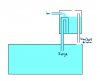
The design I was thinking of is the siphon one. It will be loud, but simple. The siphon starts when the water line gets about where it is in my artistic rendering.
The design I was thinking of is the siphon one. It will be loud, but simple. The siphon starts when the water line gets about where it is in my artistic rendering.
Attachments

SaltCreep
Non-member
If you were to limit the size of the opening where its labeled SURGE, that may give any bubbles time to rise.
Of course that may defeat the whole purpose.....
Also...what if you drilled a series of small holes in that pipe near the tanks water surface it would allow that air to escape.......
Just my thoughts after 2 cups of strong French Roast....
Of course that may defeat the whole purpose.....
Also...what if you drilled a series of small holes in that pipe near the tanks water surface it would allow that air to escape.......
Just my thoughts after 2 cups of strong French Roast....
NateHanson
Non-member
Mmmmm. French Toast . . . aaaauuuugghhhhh
Would the Reverse Carlson create bubbles? I'd think since the water is entering the tank so slowly, then rushing back INTO the bucket, the bubbles would be created in the bucket, then have time to rise out.
Would the Reverse Carlson create bubbles? I'd think since the water is entering the tank so slowly, then rushing back INTO the bucket, the bubbles would be created in the bucket, then have time to rise out.
OP
OP
~Flighty~
Now with more baby
The drain line to a lower level, so once the siphon starts it will suck the top tank dry, breaking the siphon. Then the tank fills again and the siphon doesn't start on its own until the level gets to where it is in my professional artist's rendering.
hahahahaha... wait, what?
Mmmmm. French Toast . . . aaaauuuugghhhhh
hahahahaha... wait, what?

Dave
Formerly Rosey
This thread has a surge bucket. http://www.bostonreefers.org/forums/showthread.php?t=25238&highlight=surge+device

OP
OP
~Flighty~
Now with more baby
Because these are magnifica and possibly someday gigantea anemones which require the highest light and highest random flow we can give them. I will need to house them for 6 months before and probably 6 months after the cutting also, so I need optimum conditions for them.

jacqur
This is why I don't surf.
I have been tossing around surge device ideas for as long as I can remember. I don't plan on making one due to space constraints but have an idea for a relatively quite and bubble free design. Bubbles are definitely the challenge . Anyway - the downside is cost.
Idea: Have a storage device for the surge reservoir. Obviously dependent on space and size of tank. For a 125 gallon tank I might suggest 2-4 gallon, but haven't done any tests. A 5 gallon bucket would work, or a small acrylic tank.
I think the trick is to have as large a diameter discharge as practical to add a the reservoir quickly, thus making the surge or wave. I suggest 1.5" at minimum prefferably 2".
The reservoir must be elevated above the tank for gravity flow. Use an automated ball valve on the discharge pipe below the reservoir as close to the tank water level as possible. These are available 110v AC or a 12v DC. When the valve is opened you would dump 2-4 gallons in probably about 5-10 seconds (just guessing, haven't done the calcs, but would be easy to figure out). There would be no bubbles unlike a siphon system.
2 options for triggering the system. Either use a 1/2" or such tubing split from your return tank to fill the reservoir - effectively taking a few minutes to fill. A pair electronic float switches could then trigger the valve (DC valve well suited for this configuration). Or use a digital timer that would take some experimentation to get the timing right. (Either AC or DC could work here but AC may require less eelctrical engineering knowledge)
Down side is this - reliable actuated ball valve of 1.5 - 2" diameter is probably in the $300 range.
I think with some time and effort this could be an surge device and quiet and reliable, but cost is significant and will take some time to perfect.
Just my $0.02.
Idea: Have a storage device for the surge reservoir. Obviously dependent on space and size of tank. For a 125 gallon tank I might suggest 2-4 gallon, but haven't done any tests. A 5 gallon bucket would work, or a small acrylic tank.
I think the trick is to have as large a diameter discharge as practical to add a the reservoir quickly, thus making the surge or wave. I suggest 1.5" at minimum prefferably 2".
The reservoir must be elevated above the tank for gravity flow. Use an automated ball valve on the discharge pipe below the reservoir as close to the tank water level as possible. These are available 110v AC or a 12v DC. When the valve is opened you would dump 2-4 gallons in probably about 5-10 seconds (just guessing, haven't done the calcs, but would be easy to figure out). There would be no bubbles unlike a siphon system.
2 options for triggering the system. Either use a 1/2" or such tubing split from your return tank to fill the reservoir - effectively taking a few minutes to fill. A pair electronic float switches could then trigger the valve (DC valve well suited for this configuration). Or use a digital timer that would take some experimentation to get the timing right. (Either AC or DC could work here but AC may require less eelctrical engineering knowledge)
Down side is this - reliable actuated ball valve of 1.5 - 2" diameter is probably in the $300 range.
I think with some time and effort this could be an surge device and quiet and reliable, but cost is significant and will take some time to perfect.
Just my $0.02.

I have done the toilet valve surge and presently have the siphon surge running right now.
My two cents ... the toilet valve delivers the most power(used a 2" return in 5gallon home depot bucket ... flushed like a toilet. ... tune this one right and you will have wave.
With the siphon using the 1" pipe ... there's a fair amount of large bubbles ..even with a air escape hole 2" above the tank level. When using the 3/4" pipe ....bubbles were minimum, but not a lot power.
My two cents ... the toilet valve delivers the most power(used a 2" return in 5gallon home depot bucket ... flushed like a toilet. ... tune this one right and you will have wave.
With the siphon using the 1" pipe ... there's a fair amount of large bubbles ..even with a air escape hole 2" above the tank level. When using the 3/4" pipe ....bubbles were minimum, but not a lot power.
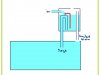
What you need to do is install a siphon break/air evacuation line. Drill a hole at the very top of the elbow of your siphon line. Attach a small diameter pipe to the hole and with 2 elbows expand the pipe down to just above the siphon line (Red line). Also cut the inlet of your surge pipe with 2 45 angles so its pointed like a v. That way the siphon quickly breaks reducing your bubbles. There is also an internal carlson device which I think has very little bubble production, but I couldnt find much info on whether or not it produces bubbles. Anyway, to make one of those is real simple. You have a bucket, cut a hole in the bottom with a bulkhead and a stand pipe. Have a larger diameter pipe that is slightly taller that is capped and has large slots cut out in the bottom sit over the stand pipe. In this design as the bucket fills the water flows under the slots and in between the two pipes. Once the water is over the stand pipe a siphon is created and the water flushes out until the siphon is broken by the slots. Again, Im not sure of the bubble production of that device, but it is extremely easy to make.
Attachments

RichConley
Attack of the Killer Cute
Cindy, why not just have it dump into an area with some baffles? Basically a bubble trap. You'd get plenty of water movement, but it'd pull the bubbles out.
I have used and experimented with surge devices for about 5 years now.
I currently have two running on my 180g system that have been running no stop for the last 3 years.
The reverse carlson surge device won't produce any bubbles if it's controlled to stop it's surge before the bucket empties, and then it would probably be minimal. Unfortunatly this type of device takes up alot of room "inside" the tank and requires some mechanical or electrical means of controlling the air input and/or removal, this can get complicated.
The regular carlson surge device (Cindy's original drawing) creates a few bubbles at the beginning a great deal of bubbles at the end of it's surge cycle. But it's pretty fool proof and should work flawlessly for just about eternity.
The toilet surge device is the one that I use. It's very simple and can run endlessly without any adjustment or maintenance. The problem is that it can be loud and it can create bubbles. The noise and the bubbles can be all but eliminated at the expense of water output velocity.
The actuated ball valve method can eliminate all of the problems of the others at the expense of lots of money and some electronics.
The wavemaker idea won't be exactly as random as possible but you don't have to worry about any noise or bubbles and there are many wave maker devices to choose from. You can increase the randomness of your flow by pointing two powerheads towards eachother and putting them on seperate time schedules, or sperate wavemakers. This way you get random flow due to the interaction where the two power head streams come together, which will be further enhanced by the fact that each powerhead will be on/off at different times. Maybe even try four powerheads on four timers, all pointing at the same central point in the tank, talk about random currents.
Good luck
Jon
I currently have two running on my 180g system that have been running no stop for the last 3 years.
The reverse carlson surge device won't produce any bubbles if it's controlled to stop it's surge before the bucket empties, and then it would probably be minimal. Unfortunatly this type of device takes up alot of room "inside" the tank and requires some mechanical or electrical means of controlling the air input and/or removal, this can get complicated.
The regular carlson surge device (Cindy's original drawing) creates a few bubbles at the beginning a great deal of bubbles at the end of it's surge cycle. But it's pretty fool proof and should work flawlessly for just about eternity.
The toilet surge device is the one that I use. It's very simple and can run endlessly without any adjustment or maintenance. The problem is that it can be loud and it can create bubbles. The noise and the bubbles can be all but eliminated at the expense of water output velocity.
The actuated ball valve method can eliminate all of the problems of the others at the expense of lots of money and some electronics.
The wavemaker idea won't be exactly as random as possible but you don't have to worry about any noise or bubbles and there are many wave maker devices to choose from. You can increase the randomness of your flow by pointing two powerheads towards eachother and putting them on seperate time schedules, or sperate wavemakers. This way you get random flow due to the interaction where the two power head streams come together, which will be further enhanced by the fact that each powerhead will be on/off at different times. Maybe even try four powerheads on four timers, all pointing at the same central point in the tank, talk about random currents.
Good luck
Jon

Similar threads
- Replies
- 32
- Views
- 5K


Sponsors
Acro Garden
All Things Aquatic
Backwoods Reefs
Beantown Reefers
Blue Light Aquatics
Bull Reef Aquaculture
Classic Corals
Corals Kingdom
Crazy Corals
Cultivated Reef
Daves Corals
Frag Freaks
Frank's Frags
Joe's Fishy Business
Love The Reef
Mofo Corals
NEMO
On Point Corals
ReefBum
Reef Exclusive
The Coral Farm
Ultimate Corals
Wet Pets Emporium
WickedCoralGarden
All Things Aquatic
Backwoods Reefs
Beantown Reefers
Blue Light Aquatics
Bull Reef Aquaculture
Classic Corals
Corals Kingdom
Crazy Corals
Cultivated Reef
Daves Corals
Frag Freaks
Frank's Frags
Joe's Fishy Business
Love The Reef
Mofo Corals
NEMO
On Point Corals
ReefBum
Reef Exclusive
The Coral Farm
Ultimate Corals
Wet Pets Emporium
WickedCoralGarden