

Matt L.
Non-member
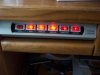
Yesterday, I finished a project I've been working on for a few weeks. I fabricated an electrical box of sorts for my reef tank. Here is a picture of it:

The were several purposes to building this electrical box:
Here is a photo of the back before I put the back panel on, showing the wiring:

And here is the back/side after I affixed the panel:

I am maxing a different electrical panel for the lighting. The reason I needed two panels is so that the height would be low enough for it to fit behind a cabinet and be out of sight. The second panel will be just for lighting, which is the single largest amperage draw, and this will also permit it to be plugged in to a different outlet,
Matt
The were several purposes to building this electrical box:
- I wanted to get away from power strips. Power strips have several nasty downsides, the chief of which (in my opinion) is that they are designed to lay on the ground. In a saltwater environment, that isn't necessarily the best place for them.
- Other downsides to power strips are that the plugs are too close together to permit effective use of transformers or x10 modules, and that it is rare to find a power strip where each outlet is on a separate switch, therefore requiring the device to be (painstakingly, often) unpligged by hand. The electrical box I wanted to design would feature multiple "individual" oulets each on their own switch, with a master switch controlling several outlets.
- I wanted GFCI protection, but not the entire fish tank on one GFCI in case it tripped. Using several different GFCIs permits the fish tank to continue operating in case one trips, but not the other. The problem I had with external GFCIs from Home Depot is that if you unplugged them, you would have to manually reset them. Using hardwired GFCIs does not require a manual reset, and therefore, if there is a power failure, the system keeps on running.
- I was concerned about amperage through multiple power strips. The electrical box is wired for 15Amp/outlet and 20Amp maximum, although as long as it is plugged into an outlet, it can only handle 15Amp maximum, which is still far more than I draw at peak.
Here is a photo of the back before I put the back panel on, showing the wiring:
And here is the back/side after I affixed the panel:
I am maxing a different electrical panel for the lighting. The reason I needed two panels is so that the height would be low enough for it to fit behind a cabinet and be out of sight. The second panel will be just for lighting, which is the single largest amperage draw, and this will also permit it to be plugged in to a different outlet,
Matt




 I have one GFI breaker set deticated for the entire aquarium. The rest of my outlets are standard. I could run an alarm through a relay that when the GFI de-energised it would sound an alarm. Oh no another project

