
• ******* To read about the changes to the marketplace click here

FAIL SAFE SUMP opinions needed

itz216

Non-member
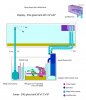
I'd like to add a sump / refugium to my display tank - BUT it must be "fail safe" - no overflowing!!! I've done some research, but need experienced reefer(s) to confirm / tweak before I drill : ) Any suggestions / experience you might share is greatly appreciated. NOTE: drawing doesn't show it - but I'm not drilling the bottom - just the back.
 

Attachments

  • sump001.jpg
    sump001.jpg
    81.3 KB · Views: 1,464
your drawing looks fine. You will need to have some sort of siphion break on the retrun line, and a way to prevent any snails or other obstructions from getting into the drain lines (the pic shows mesh over the box, but I'd want strainers on the drains as well).
 
Thx John. Appreciate your thoughts.

Can you give me details on the siphon break on the return? Is it just a small tube that is above the waterline and shoots small amount of water into the tank until called upon to draw air?

How safe is this set up - IYO? Anything I should be aware of in case of a power outage?
 
I hope you're going to incorporate some durso's on your drains.
Otherwise you're going to go deaf from the constant flushing.lol
JMO,but I would also send half your overflow directly to the refugium.
 
Just as a reminder double check the maker of the 55 gal and that it is not made of tempered glass, some of the 55s have tempered sides too.
 
I would remove the final uner bubble trap before the return as well. Better to have any bubbles left be at the surface when going in that area. And as John said, use strainers on the drains. You can do an external durso which is what I have on my tank. The drains are set up the same way with a small box siliconed to the inside to surface skim. Off the bulkhead in the back is a T with a pipe sticking up that is capped with an air hole and the drain coming down.

I would also change the design a bit to have the fuge first and put the skimmer in the middle. Then bypass some of the flow to dump directly to the skimmer chamber. Usually we want high flow but low turnover in a fuge and more turnover with the skimmer. This way part of the flow goes to the fuge and all of the flow goes to the skimmer. This really depends on the size skimmer and the return pump you are using though.

Edit: just looked at your drawing agin to see if you had the actual equipment. I wouldn't really worry about to much flow through the fuge with the mag 5. You should be fine to leave it the way it is, I would still remove that last baffle though.
 
Last edited:
Isn't the AquaC Pro a Hang on back? I have mine running hanging off the back of the sump. Otherwise the drawing looks almost identical to my setup minus the last bubble trap, seems over kill to me. Just be sure to test, test, and retest simulated power outages.
 
A siphion break is any way that the siphon will be interrupted when the return pump is shut off or the power goes out. This can be a little hole in the return pipe, having the return close enough to the surface that the siphion will break on it's own, or any other creative idea you might come up with.
 
one last thing....as someone who wet-vac'd 40+ gallons of saltwater up in my basement this morning* from my sump system leaking...there are no absolutes in reefing, except that you will absolutely have some spillage, some time, some how...some way.


* the spillage was due to a combo of laziness and temporary plumbing :D
 
one last thing....as someone who wet-vac'd 40+ gallons of saltwater up in my basement this morning* from my sump system leaking...there are no absolutes in reefing, except that you will absolutely have some spillage, some time, some how...some way.


* the spillage was due to a combo of laziness and temporary plumbing :D

You sure seem to have a lot of spills Jay, should we have a plumbing seminar at your house:rolleyes:
 
Design

My advice is to use oversized pipes for your drains. Instead of using 1 inch drain pipes go to 1-1/2 drains or larger (if practical). I really do not like Dursos and do not have any in my system. Also, the little hole to prevent siphoning during a power outage is not reliable and may need constant cleaning to allow air to enter it to prevent siphoning of water. One type of overflow occurs when your drain pipes clog from a snail or other debris. Then your display tank can't drain water and eventually floods. A larger pipe diameter will help prevent this but you should also use overflow boxes and multiple drains in your display tank. Using multiple drains further increases the amount of air in drain pipes thus reducing the changes of display tank floods and sump floods. Larger drains will also make them virtually silent without the need for Dursos.

You need to use a big enough sump as well with extra holding capacity when the power is off and water drains from your display tank into the sump. This is THE ONLY reliable way, in my opinion, to prevent a sump from over-flowing.

I would also try not to submerge your return line if possible or at least make sure that it is positioned, along with the drains as high as practically possible in your display tank. You should at least make sure that the amount of water above the lowest drain/return line fits into the sump during a power outage. Again, you need to oversize the sump to accomodate the volume of water above the lowest point of water inlet/outlet into your display tank. This volume can be calculated by the (Height x Width x Length) cu in / 231 cubic inches per gallon of the "block" of water above the lowest drain/return.
 
Last edited:
...I'm removing the last baffle, adding the auto shut off and Durso. Moving the skimmer to HOB position with an overflow for the skim mate, a siphon break to the return line and strainers on the drains.

Anybody know how you tell ( without knowing the maker - if a tank has tempered glass sides?). Or where is the makers mark? Tank isn't new - standard looking black trim 3/8" glass 55G.

PVC cement - Lowes' display said to use ABS cement ( black). Correct?

How big should the overflow box be?

Thx for all the input so far.:)
 
I agree with Chuck about having the return line as close to the surface as possible and not bother with anti siphon holes. I have an extra overflow box that I made when making mine, long story behind that :) You are welcome to it if ever in the Marlboro area. It is black acrylic and has all the teeth already cut out. Would work nice on a 55 I think, they were for my 140 but the tank is only 36" long where yours is 48".
 
"PVC cement - Lowes' display said to use ABS cement ( black). Correct?"

You can just use the Oatley stuff.Most use the clear primer now as it's less messy looking

"How big should the overflow box be?"
I've seen a calculator somewhere,I'll see if I can locate it for you.
 
I agree with Chuck about having the return line as close to the surface as possible and not bother with anti siphon holes. I have an extra overflow box that I made when making mine, long story behind that :) You are welcome to it if ever in the Marlboro area. It is black acrylic and has all the teeth already cut out. Would work nice on a 55 I think, they were for my 140 but the tank is only 36" long where yours is 48".

A agree as well (should have said so earlier), having the return high enough that it will automatically break siphion is IMO the best way to do it.
 
How close to the edge of the glass is "safe" to drill?
Any way to determine tempered glass / not tempered?
Any downside to running 1 1/2" drains w/ wo Dursos?

I'm assuming that setting my baffle heights will determine both a "normal" running height for water in the sump and allow me to set the amount of "extra" display water that the sump can accommodate.
 
Not sure why you are putting a mesh mod pump on the AquaC? They are a injector/venturi skimmer the meshmod will kill the effectiveness of the injector.

Fact is the Durso mod would work well here. but the only part of the durso
that would be in the overflow would be the first elbow. The stand pipe would be outside of the tank. Durso's do not work on a siphon so there is no need to worry about breaking a siphon with a drilled tank.
However on some setup to get them to work optimally you need a reverse durso to balance things out.

You also want to avoid straight vertical drops. problem with straight vertical drops is that you have air coming up and water going down if the water and air can pass each other then you get flushing. Pipes should meander

An high quality level sensor more like a few could save you alot of trouble.


Also knowing how much water you will need to account for will help
Sump volume calculator, what you need to account for when the pump is off and the tank drains down to overflow height
http://reefcentral.com/calc/sump.php

Some of this comes down to who you are and how you think. As well as some trial and error. There are fails safe measure but nothing is fail safe.
 
Last edited:
How close to the edge of the glass is "safe" to drill?
Any way to determine tempered glass / not tempered?
Any downside to running 1 1/2" drains w/ wo Dursos?

I'm assuming that setting my baffle heights will determine both a "normal" running height for water in the sump and allow me to set the amount of "extra" display water that the sump can accommodate.

If you use overflow boxes, then these will set the level of the water at least for the drains. So you only have to worry about the return. Not sure about glass but on my acrylic tank, I left around 1 inch between the top of the tank edge and the top of the drain bulkhead. You can keep the return out of the tank all together by suspending the return pipe above the water, in the same manner as a "Calfo Loop". Calfo Loop is just a method to distribute the return water over many return nozzles connected together by a common return pipe. The whole loop is composed of a pipe running around the whole tank or a portion of the tank with tees and multiple return ports.

I believe that tempered glass is used only on the bottoms of glass tanks but maybe others with glass tanks could chime in and confirm this.

No downside to running oversized pipes. The Dursos just quiet down noisy drains. But with oversized pipes you will always have air in them and so you do not need Dursos.

Yes to your last statement for normal operation with power on. However, if the return pipes are below the baffle height of your overflow boxes, water will drain from the returns as well in a power failure,to a level below the baffles in your overflows. So you need to allow for a further drop in water level during a power outage. You can calculate the reserve you need pretty easily: HxLxW/233 = total water volume (H,L,W in inches). So if your water level with the power off drops by 1 inch then you need 1 inch x length of tank (inches) x width of tank (inches) / 233 gallons of reserve in your sump.
 
Last edited:
Back
Top