
• ******* To read about the changes to the marketplace click here

Geothermal Loop in basement

skatezen

If you pick it, Flick it!
I was talking about this with Marco at NERAC this weekend. I will be pouring a new slab of concrete over the existing one to level the floor and have it slope toward the drainage hole, which is currently about 3 inches above the lowest point of the floor ? not helpful when your tank floods. I was wondering if I ran say 200ft of 1/4" or 3/8" Polyethylene tubing, fed by a delivery pump, in a zig-zag over the existing floor and then covered it with the new cement, would be an efficient way of cooling my tank in the warmer months? As a heat transfer in the tank I would make an "egg crate radiator" and weave the tubing through egg crate panels. The solution in the tubing would be saltwater (not tank water) - to act as antifreeze. I presume flow rates in the tubing and flow through the radiator tank would need to be adjusted for optimal cooling.

I hope my illustration helps.


I also found out this information:
Thermal conductivity of Water 0.58
Thermal conductivity of Polyethylene HD 0.5
Thermal conductivity of Cement, portland 0.29
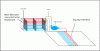
 

Attachments

  • Radiator.gif
    Radiator.gif
    9.3 KB · Views: 517
There are house that use this exact method to cool the house, on a larger scale
 
Just don't make the mistake that I did (or Marvin did depending upon how you look at it), don't use tubing that is too thick to allow the heat transfer into the ground to be effective.
 
Greg what would be a good thickness? I was going to use standard RODI tubing the wall thickness is 1/16"

Also would 200ft in cement and 125 in the radiator be good enough?

I wanted to note that I took the temperature of the cement today and it is was a steady 63.3 degrees. Also forgot to mention in the previous post that the supply pump would be connected to a Ranco temperature controller to control the cooling system.
 
skatezen said:
I was going to use standard RODI tubing the wall thickness is 1/16"

Besides the concern regarding wall thickness, I think ideally you'd want to maximize the contact area (exchange surface) with the cement by going with a larger diameter pipe... RODI tubing may be too narrow for this purpose.

Nuno
 
nunofs said:
Besides the concern regarding wall thickness, I think ideally you'd want to maximize the contact area (exchange surface) with the cement by going with a larger diameter pipe... RODI tubing may be too narrow for this purpose.

Nuno


Think 3/8ths would be better? 1/2"? Greg used 3/4, but his wall thickness was too great and didn't transfer heat well.
 
The problem also with a long length of small diameter tubing is that you will have a very large pressure drop. Even with my larger diameter tubing I had a large pressure drop. I had to purchase a special, and quite expensive recirculation pump for the loop. It worked well (the pump), but when I found out the loop would not cool sufficiently, I turned off the pump and now it sits. Need one? :D

Also, if the tubing you are imbedding is in the upper portion of the slab, you might find that you quickly heat the room, and then the loop no longer works much. This will depend upon how thick of a slab you are pouring, and over how large an area you can space out the tubing.

I agree with the idea of using the water in the loop only as a heat exchange fluid. If you use DI water with a high concentration of salt (rock salt, do not use an aquarium salt mix), nothing will grow in it, and it will never freeze.
 
skatezen said:
Think 3/8ths would be better? 1/2"? Greg used 3/4, but his wall thickness was too great and didn't transfer heat well.

Since there will be no contact with actual tank water, you could go with metal pipe (brass, for instance) instead of PVC pipe for the underground part of the loop, and heat transfer would no longer be an issue... then you'd adapt to thin-wall PVC (I think it's schedule 20, or something like that) for the in-tank part of the loop (to avoid contact between the brass pipe and the tank water). But I'm just thinking out loud, and haven't actually done this before, so please take it with a large grain of salt and listen to Greg ;)

Nuno
 
Nuno, pretty much any metal pipe embedded in concrete will corrode away quickly. Plastic is the only way to go, though you sacrifice big time in the way of heat xfer. Usually what is done is thin aluminum spreader plates are wrapped around the plastic tubing to help increase the heat transfer area, and since its just a plate and not part of the tube, corrosion doesn't matter.
 
nunofs said:
Since there will be no contact with actual tank water, you could go with metal pipe (brass, for instance) instead of PVC pipe for the underground part of the loop, and heat transfer would no longer be an issue... then you'd adapt to thin-wall PVC (I think it's schedule 20, or something like that) for the in-tank part of the loop (to avoid contact between the brass pipe and the tank water). But I'm just thinking out loud, and haven't actually done this before, so please take it with a large grain of salt and listen to Greg ;)

Nuno

Funny, I though of this in the shower this morning.
 
>The problem also with a long length of small diameter tubing is that you will have a very large pressure drop. Even with my larger diameter tubing I had a large pressure drop. I had to purchase a special, and quite expensive recirculation pump for the loop. It worked well (the pump), but when I found out the loop would not cool sufficiently, I turned off the pump and now it sits. Need one?<

I would need a pump..PM me about that. What would you recommend as far as tubing goes? Would it be possible to use the copper coil stuff or would the saltwater and confines of the concrete corrode it?

>This will depend upon how thick of a slab you are pouring, and over how large an area you can space out the tubing.<

The area will I will be imbedding the tubing will be in my display room. All other equipment will be in my garage. the size of the room its self is 10x20, but if I needed more room to expand the loop I have a good sized hallway the total square footage would be 300sq.ft. The slab will vary in thickness, probably 2 to 3" above, with a tile floor on top of that and a good at least 8" under. Tubing would be placed 6 or so inches apart.

>I agree with the idea of using the water in the loop only as a heat exchange fluid. If you use DI water with a high concentration of salt (rock salt, do not use an aquarium salt mix), nothing will grow in it, and it will never freeze.<

What would be the ideal salinity?
 
>Nuno, pretty much any metal pipe embedded in concrete will corrode away quickly.<

Is this true? I'm just theorizing here....if it corroded away, you might be left with channels in the concrete which the water could still flow through. OTOH, the concrete might be too porous and the water would seep out?

Any way to make concrete that is very non-porous?

I considered copper, but I also was worried about it corroding away in the dirt (mine was to be in dirt, not concrete) and I didn't want to have to replace it regularly (would require lots of digging). My other concern was that there was alway a chance that the heat transfer fluid in the lines might accidentily leak into the sump, and water saturated with copper is NOT a healthy thing for a reef tank.

The other option I considered was using some other type of metal for the tubing, but then again, it doesn't take long to run into large $ for the project.

If I had to do it again, I would try and perhaps bury several large plastic containers with a large surface area (not tall) in the ground and join them all together, and pump water from the sump into the most distant container. Still starts to sound expensive fast.

I'd thought a while back that if you have access to a deep lake (10 feet or so) you could put a long coil of tubing at the bottom of the lake and run water through that.
 
Greg Hiller said:
>Nuno, pretty much any metal pipe embedded in concrete will corrode away quickly.<

Is this true? I'm just theorizing here....if it corroded away, you might be left with channels in the concrete which the water could still flow through. OTOH, the concrete might be too porous and the water would seep out?
The lime in the concrete corrodes the pipe. There is a neighborhood in Hudson that the builders installed radiant heat in the basement floors using copper. It corroded and the floors cracked over the years causing the heating system to leak. They had to redo all the houses basement heat years later.
 
>What would be the ideal salinity?<

I would go quite high so there is no chance of anything growing. When I ran the calculations I also was concerned about freezing in the loop since I figured I'd not use it in the winter. I was able to calculate out (using the handy CRC handbook of Chemistry and Physic) the concentration of salt required to keep the freezing point much lower than would ever be possible in Massachusetts, even if the tubing was above ground. I also calculated that the volume of the loop if the whole thing were to accidentialy dump into my sump would probably not kill anything due to the slight increase in salinity. After all my cool calculations and planning though, my loop did not work just due to the thickness of the tubing. :mad:
 
>They had to redo all the houses basement heat years later.<

Yuk!!
 
dave601m said:
Nuno, pretty much any metal pipe embedded in concrete will corrode away quickly.

Oops... there goes my "big" idea :o :( ... I'm glad I wrote "haven't actually done this before, so please take it with a large grain of salt" :)

Nuno
 
Greg,
What was the wall thickness of the tubing you used?
 
I think it was about 1/8"
 
Hmmm, you all just gave me an idea. We have an extra well on our property that has a water level that is about 15 feet below grade. I wonder if I could do a loop in and out of that....
 
I have an article or two that (very briefly) describes under floor radiant heaters, which is basically what you'd be setting up. i'll see if i can photocopy it and bring it to the meeting for you on Sat, if you want.
it doesn't go into any sort of depth about anything technical, but just shows some typical installs and tube layouts and discusses materials.

Also, how much water do you need to cool, and how many degrees do you need to cool it by at worst case scenario? you may just be able to use a simple radiator and a small fan to dissipate heat into the basement air if it's not too much.
 
Back
Top