
-
******* To read about the changes to the marketplace click here
You are using an out of date browser. It may not display this or other websites correctly.
You should upgrade or use an alternative browser.
You should upgrade or use an alternative browser.
Paul B's thread
- Thread starter jamesdong009
- Start date


BiGGiePauls33
Current BRS President | Employee of Reef Exclusive
Staff member
Moderator
Officer
BRS Member
Morning PaulGood Morning.
View attachment 207069
This beautiful morning I came across this dead shark on the beach. It looks like something much bigger bit the thing in half and only left some guts.
View attachment 207070

Probiotics and immunity: A fish perspective
Get rights and content
Abstract
Probiotics are usually live microorganisms which when administered in adequate amounts confer a health benefits on host. Nowadays, probiotics are also becoming an integral part of the aquaculture practices to obtain high production. The common probiotics that are used for aquaculture practices include Lactobacillus, Lactococcus, Leuconostoc, Enterococcus, Carnobacterium, Shewanella, Bacillus, Aeromonas, Vibrio, Enterobacter, Pseudomonas, Clostridium, and Saccharomyces species. The involvement of probiotics in nutrition, disease resistance and other beneficial activities in fish has proven beyond any doubt.
Among the numerous health benefits attributed to probiotics, modulation of immune system is one of the most commonly purported benefits of the probiotics and their potency to stimulate the systemic and local immunity under in vitro and in vivo conditions is noteworthy. Different probiotics either monospecies or multispecies supplementation can eventually elevate phagocytic, lysozyme, complement, respiratory burst activity as well as expression of various cytokines in fish.
Similarly, probiotics can stimulate the gut immune system of fish with marked increase in the number of Ig+ cells and acidophilic granulocytes. Furthermore, mono-bacterial association studies (with non-probiotic bacterial strains) in gnotobiotic fish also indicate the up-regulation of various immune related genes. Though the exact mode of action of probiotics is yet to be established in any animal including fish, probiotics often exert host specific and strain specific differences in their activities.
Various factors like source, type, dose and duration of supplementation of probiotics can significantly affect the immunomodulatory activity of probiotics. The review is therefore, aiming to highlight the immunomodulatory activity of probiotics and also to evaluate the factors that regulate for the optimum induction of immune responses in fish.
End Quote
The kidney and spleen make antibodies specifically built to fight each particular antigen (invading disease). This process can take up to two weeks. The antibodies attach themselves to their antigen and fight it in one of three ways:
It is important to note that environmental pollution also hampers the immune system and reduces a fish’s response to pathogens.
Immunology of Fish
Thelma C Fletcher, University of Aberdeen, Aberdeen, UK
Christopher J Secombes, University of Aberdeen, Aberdeen, UK
Published online: November 2015
DOI: 10.1002/9780470015902.a0000520.pub3
Quote:
Abstract
Innate immunity provides some form of defence against pathogens in all multicellular organisms but with cartilaginous and bony fish, although the lowest group of jawed vertebrates, the addition of a classic adaptive immune response becomes apparent. This provides the refinements of specificity for antigen recognition and memory. The T and B lymphocytes are the effector leucocytes, acquiring their antigen‐specific receptors (immunoglobulin for B cells and T‐cell receptor for T cells) in the anterior kidney (bone marrow being absent) and thymus. The B cells are responsible for the production of antibodies that function as different immunoglobulin classes, whereas subsets of T lymphocytes are capable of killing target cells or helping with B‐ and other T‐cell functions. Knowledge of these mechanisms is important for the use and design of vaccines, now so essential for the aquaculture industry, whereas studies of fish immunology contribute to the understanding of the evolution of adaptive immunity.
- S.K. Nayak
- Laboratory of Fish Pathology, Department of Veterinary Medicine, College of Bioresource Sciences, Nihon University, Japan

Get rights and content
Abstract
Probiotics are usually live microorganisms which when administered in adequate amounts confer a health benefits on host. Nowadays, probiotics are also becoming an integral part of the aquaculture practices to obtain high production. The common probiotics that are used for aquaculture practices include Lactobacillus, Lactococcus, Leuconostoc, Enterococcus, Carnobacterium, Shewanella, Bacillus, Aeromonas, Vibrio, Enterobacter, Pseudomonas, Clostridium, and Saccharomyces species. The involvement of probiotics in nutrition, disease resistance and other beneficial activities in fish has proven beyond any doubt.
Among the numerous health benefits attributed to probiotics, modulation of immune system is one of the most commonly purported benefits of the probiotics and their potency to stimulate the systemic and local immunity under in vitro and in vivo conditions is noteworthy. Different probiotics either monospecies or multispecies supplementation can eventually elevate phagocytic, lysozyme, complement, respiratory burst activity as well as expression of various cytokines in fish.
Similarly, probiotics can stimulate the gut immune system of fish with marked increase in the number of Ig+ cells and acidophilic granulocytes. Furthermore, mono-bacterial association studies (with non-probiotic bacterial strains) in gnotobiotic fish also indicate the up-regulation of various immune related genes. Though the exact mode of action of probiotics is yet to be established in any animal including fish, probiotics often exert host specific and strain specific differences in their activities.
Various factors like source, type, dose and duration of supplementation of probiotics can significantly affect the immunomodulatory activity of probiotics. The review is therefore, aiming to highlight the immunomodulatory activity of probiotics and also to evaluate the factors that regulate for the optimum induction of immune responses in fish.
End Quote
The kidney and spleen make antibodies specifically built to fight each particular antigen (invading disease). This process can take up to two weeks. The antibodies attach themselves to their antigen and fight it in one of three ways:
- Detoxify it – so that white blood cells can ingest and destroy it
- Attract a “compliment” – another blood component that helps destroy the antigen
- Deactivate reproduction – to stop the antigen proliferating
It is important to note that environmental pollution also hampers the immune system and reduces a fish’s response to pathogens.
Immunology of Fish
Thelma C Fletcher, University of Aberdeen, Aberdeen, UK
Christopher J Secombes, University of Aberdeen, Aberdeen, UK
Published online: November 2015
DOI: 10.1002/9780470015902.a0000520.pub3
Quote:
Abstract
Innate immunity provides some form of defence against pathogens in all multicellular organisms but with cartilaginous and bony fish, although the lowest group of jawed vertebrates, the addition of a classic adaptive immune response becomes apparent. This provides the refinements of specificity for antigen recognition and memory. The T and B lymphocytes are the effector leucocytes, acquiring their antigen‐specific receptors (immunoglobulin for B cells and T‐cell receptor for T cells) in the anterior kidney (bone marrow being absent) and thymus. The B cells are responsible for the production of antibodies that function as different immunoglobulin classes, whereas subsets of T lymphocytes are capable of killing target cells or helping with B‐ and other T‐cell functions. Knowledge of these mechanisms is important for the use and design of vaccines, now so essential for the aquaculture industry, whereas studies of fish immunology contribute to the understanding of the evolution of adaptive immunity.
The lady who I was on TV with about that Viet Nam letter thing a few months ago called me yesterday to invite me to speak the week of Veterans Day about Viet Nam. It's on the Jersey Shore but I think I can do it on a Zoom call because it's about a 3 hour drive from here and I don't want to take a train. 
I found this gorgeous tree stump root on the beach of the Hudson River at my daughters house. It was in the water so long it had barnacles and mussels growing on it. Now it is sterilized and power washed so no more bark or barnacles. It will become a beautiful table base.


I just came back from my favorite LFS across the street from my wife's doctor. He was almost sold out of livestock but not to waste the trip I got 3 small fish just for kicks even though I have way to many fish.
The woman who wrote me the letter in Nam who I was on TV with called me and her Veteran group are going to interview me soon. I also have two fish interviews. My main issue is that I take my wife to doctors a few times a week and it will never end as MS doesn't get better so we try all these treatments none of which do anything but I am sure someone is making a lot of money on them.
My wife wants me to write another book. Not about fish but memoirs of Viet Nam. I was thinking, of making a novel "based" on real events but sort of like in my fish book if that is even possible. I would stretch the truth a lot to make it more interesting although the truth may be interesting enough. I will see if I want to do it.
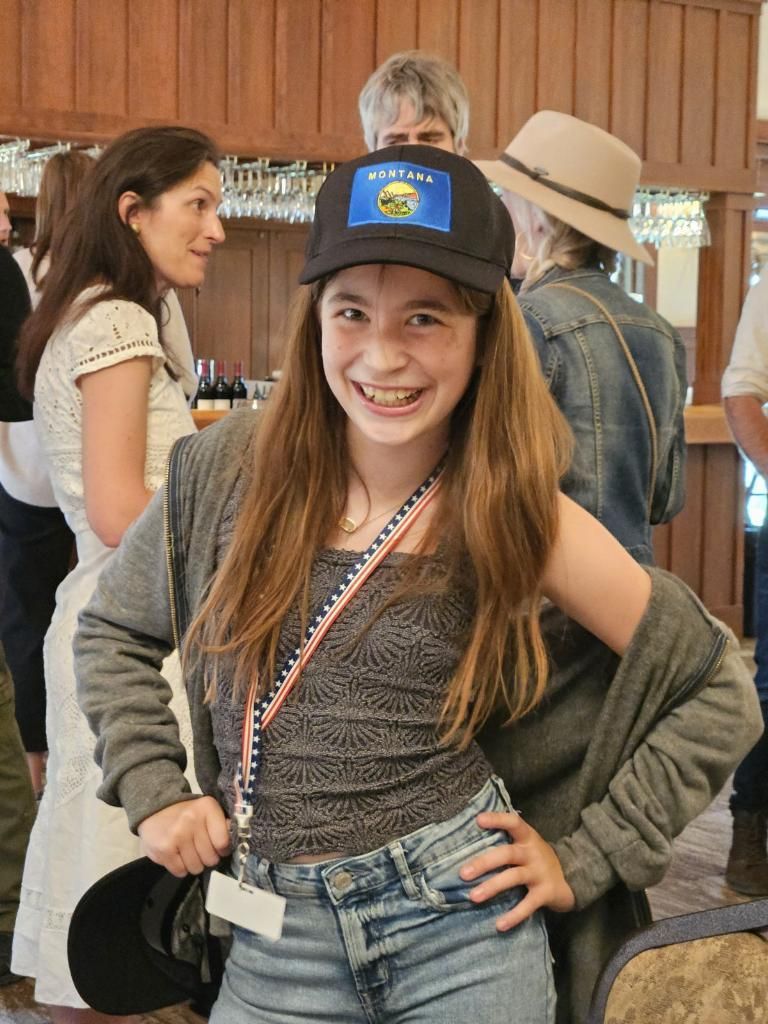
My Grand Daughter acting cool on a trip to Montana
The woman who wrote me the letter in Nam who I was on TV with called me and her Veteran group are going to interview me soon. I also have two fish interviews. My main issue is that I take my wife to doctors a few times a week and it will never end as MS doesn't get better so we try all these treatments none of which do anything but I am sure someone is making a lot of money on them.
My wife wants me to write another book. Not about fish but memoirs of Viet Nam. I was thinking, of making a novel "based" on real events but sort of like in my fish book if that is even possible. I would stretch the truth a lot to make it more interesting although the truth may be interesting enough. I will see if I want to do it.
My Grand Daughter acting cool on a trip to Montana
Today I am staining my wood root table base. Here it is before the stain dried. It will lighten up when it's dry. I think. I just wanted to bring out the grain and not necessarily darken it. It used a lot of stain because it's rough and has a lot of limbs coming off of it.
I still have to spray it with a clear coat.
In between I am also writing my new book and am up to chapter 3. It's about my time in the army and Viet Nam. Very little combat will be in it until the last chapter because I'm trying to keep it light and keep it to the fun or interesting that happened. Squeamish people can forego the last chapter.

I still have to spray it with a clear coat.
In between I am also writing my new book and am up to chapter 3. It's about my time in the army and Viet Nam. Very little combat will be in it until the last chapter because I'm trying to keep it light and keep it to the fun or interesting that happened. Squeamish people can forego the last chapter.


Wow. What are these fish?
Similar threads
- Replies
- 3
- Views
- 617


- Replies
- 8
- Views
- 1K


- Replies
- 50
- Views
- 6K
- Replies
- 7
- Views
- 2K
- Replies
- 2
- Views
- 1K

Fragsgiving 2026
Sponsors
Acro Garden
All Things Aquatic
Backwoods Reefs
Beantown Reefers
Blue Light Aquatics
Bull Reef Aquaculture
Classic Corals
Corals Kingdom
Crazy Corals
Cultivated Reef
Daves Corals
Frag Freaks
Frank's Frags
Joe's Fishy Business
Love The Reef
Mofo Corals
NEMO
On Point Corals
ReefBum
Reef Exclusive
The Coral Farm
Ultimate Corals
Wet Pets Emporium
WickedCoralGarden
All Things Aquatic
Backwoods Reefs
Beantown Reefers
Blue Light Aquatics
Bull Reef Aquaculture
Classic Corals
Corals Kingdom
Crazy Corals
Cultivated Reef
Daves Corals
Frag Freaks
Frank's Frags
Joe's Fishy Business
Love The Reef
Mofo Corals
NEMO
On Point Corals
ReefBum
Reef Exclusive
The Coral Farm
Ultimate Corals
Wet Pets Emporium
WickedCoralGarden