• ******* To read about the changes to the marketplace click here

Sad, anemone isn't going to make it

~Flighty~

Now with more baby
Well, My Magnifica isn't going to make it.

They are called one of the most difficult creatures to keep in a tank for a reason and I knew that when I set the tank up for it, but the fact that it is dying is still bumming me out.

I knew better than to get one that had a bit of a gaping mouth at the store, but I was impatient. It got progressively better in my tank for about a month, even was sticky and eating, but it never kept the mouth tightly closed. I noticed about a month ago that it was starting to gape more and after a few days I could see some necrotic tissue inside. Then it obviously started to sucumb to some sort of a tissue rot. Over the past week one spot has started disolving.

I'm not sure what to do with it. More than 3/4 of it still is inflated and looks almost like it is just splitting, but the diseased tissue is a sure sign it is dying. The clowns still are living in the intact part.

I don't know if I should take it out now or let it go slowly in the tank. I'm just a lot more sad about this than I expected to be.
 
Anemone

Sorry to hear of you anemone problems. Some things u can try before
giving up:

- Increase water flow near the anemone to carry away any waste products more efficiently

- Increase lighting intensity and/or photoperiod to give the anemone more energy to repair iself

- Increased water changes since this animal is extremely sensitive to water quality

- Increase skimming or water oxygenation via other means


Good luck, and please let me know if u have any questions...I might be able to help.


~Flighty~ said:
Well, My Magnifica isn't going to make it.

They are called one of the most difficult creatures to keep in a tank for a reason and I knew that when I set the tank up for it, but the fact that it is dying is still bumming me out.

I knew better than to get one that had a bit of a gaping mouth at the store, but I was impatient. It got progressively better in my tank for about a month, even was sticky and eating, but it never kept the mouth tightly closed. I noticed about a month ago that it was starting to gape more and after a few days I could see some necrotic tissue inside. Then it obviously started to sucumb to some sort of a tissue rot. Over the past week one spot has started disolving.

I'm not sure what to do with it. More than 3/4 of it still is inflated and looks almost like it is just splitting, but the diseased tissue is a sure sign it is dying. The clowns still are living in the intact part.

I don't know if I should take it out now or let it go slowly in the tank. I'm just a lot more sad about this than I expected to be.
 
sorry to hear. maybe you could repost on the Anemones & Clownfish forum?
 
Chuck Spyropulos said:
Sorry to hear of you anemone problems. Some things u can try before
giving up:
Before I purchased this critter I tried to achieve the best environment for it that I could, so I don't know what more I can do. Let me know if any of these things below should be changed, I really would like any advice I can get.


- Increase water flow near the anemone to carry away any waste products more efficiently
I have 2 tunze 6000s on %100 alternating very quickly Which provides a lot of chaotic flow. I have them pointed so they never blast the anemone, but the vortex they make lifts the tenticles.

- Increase lighting intensity and/or photoperiod to give the anemone more energy to repair iself
The anemone is about 6" under a de 250 MH and t5 actinics on 10 hours a day. It could climb a little higher on the rock if it wanted to.

- Increased water changes since this animal is extremely sensitive to water quality
Large fuge and sump have ment the parameters stay very stable. I have never had detectable nitrates, nitrites or phosphates. I don't do a lot of water changes, but I export a ton of macro. The temp stays very stable as does the ph. I will add an auto topoff to keep the salinity more stable.
- Increase skimming or water oxygenation via other means
I have tried turning the guard on the tunze so that air is sucked in, but with the gaping mouth I found that little bubbles were working their way into the anemone and going to the tips of some of the tenticles. There is a pretty good waterfall into the sump and a big skimmer, so I think o2 is high anyway.

Good luck, and please let me know if u have any questions...I might be able to help.
Other things I am thinking is incompatable corals in the system and chemical warefare. The tunzes blow the water across the other corals to get to the anemone. I'll change my carbon now and maybe remove some other corals before trying another magnifica.

I'm using a baister to remove disolving tissue before it gets into the water, but I think the end is near for this guy. It really looks like some sort of an infection of the tissue. you can see where the healthy tissue is white and purple and the sick tissue has brown areas.
 
I havn't removed the clowns because they don't seem to hurt it like some clowns do with anemones. If anything they help by pushing the side of the anemone up sometimes which lifts the bottom tenticles more into the flow.
 
Advice

Sounds like you are doing everything you can. Not sure aout corals releasing toxins, but as you know SPS corals need to touch to sting, but softies can and do release chemicals including terpenes into the water. I don't think that this is the problem though....I had a lot of softies with my Magnifica for a good 2 years with no problems.... Maybe you just got a diseased specimen?

I would definitely leave the clowns in...they tend to help rather than not.
Well, good luck...it looks like you are doing a great job as far as providing all you can to the anemone. Sometimes there are no answers :(


~Flighty~ said:
Before I purchased this critter I tried to achieve the best environment for it that I could, so I don't know what more I can do. Let me know if any of these things below should be changed, I really would like any advice I can get.


I have 2 tunze 6000s on %100 alternating very quickly Which provides a lot of chaotic flow. I have them pointed so they never blast the anemone, but the vortex they make lifts the tenticles.

The anemone is about 6" under a de 250 MH and t5 actinics on 10 hours a day. It could climb a little higher on the rock if it wanted to.


Large fuge and sump have ment the parameters stay very stable. I have never had detectable nitrates, nitrites or phosphates. I don't do a lot of water changes, but I export a ton of macro. The temp stays very stable as does the ph. I will add an auto topoff to keep the salinity more stable.

I have tried turning the guard on the tunze so that air is sucked in, but with the gaping mouth I found that little bubbles were working their way into the anemone and going to the tips of some of the tenticles. There is a pretty good waterfall into the sump and a big skimmer, so I think o2 is high anyway.

Other things I am thinking is incompatable corals in the system and chemical warefare. The tunzes blow the water across the other corals to get to the anemone. I'll change my carbon now and maybe remove some other corals before trying another magnifica.

I'm using a baister to remove disolving tissue before it gets into the water, but I think the end is near for this guy. It really looks like some sort of an infection of the tissue. you can see where the healthy tissue is white and purple and the sick tissue has brown areas.
 
Cindy, so sorry to hear about that... this is a suggestion from someone who knows very little about anemones, so take it with a grain of salt or two: could you force it to split, leaving the damaged part behind, by cutting the anemone into two parts? It seems you don't have much to lose if it's in such bad shape...

Nuno
 
You meen go at it with a knife? I don't know if I could do that. It couldn't hurt at this point.

I do think it was ill when I got it. From what I can tell these anemones are very suceptable to being stressed beyond recovery durring colection and shipping. They are also large enough that it can take them a long time to die.

I am not giving up on having a magnifica deticated tank, so if anyone hears of or sees a healthy one for sale let me know. I don't want to add a new one for a while in case there is a bacteria or virus that harms these guys that is in my system now. Inyone have any thoughts on how long to wait?
 
Flighty, I know it must be hard for you but could you post a pic so some of us newbs can see what an ailing anemone looks like? If not thats ok!
It seems that you are giving it great care and I hope it can heal itself.

Good luck
Steve
 
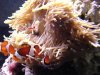
Here is a pic that shows how the stomach tissue has been exposed (that is the white tissue that the red arrow points to) compared to the normal tissue that should be exposed (blue arrow) and the deflated tenticles in the area thet now is disintegrating (green)
 

Attachments

  • anemBad.JPG
    anemBad.JPG
    79.9 KB · Views: 319
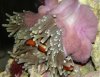
Here is a pic that shows where the anem started comming apart (red arrow)
 

Attachments

  • anemBad2.JPG
    anemBad2.JPG
    43.4 KB · Views: 332
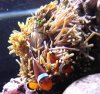
Here is a pic of about how the mouth looked most of the time after I brought it home. In a healthy one there should be none of the white part (red arrow)showing
 

Attachments

  • anemBad3.JPG
    anemBad3.JPG
    58.1 KB · Views: 297
OMG!!! Sad but informative pics and the clowns definately have not given up on their home either. I hope it works out ok for all.

Thanks for the pics
Steve
 
Am I following correctly that the dying tissue is starting / started at the base? If so I would guess that the foot was torn due to improper handling at the store or their supplier or collector. I've read that this can be one of the biggest risks, once the bacterial infection starts there's not much that can be done.

You also mentioned adding an auto top off. I have also read that Ritteris are super sensitive to salinity fluxuations. This probablly isn't the cause but it would be one way to reduce stress in hopes of possible healing.

I kept one for about a year and I saw the gaping appearance of the mouth and deflated tentacles regularly. From what I could see in the pic that looks like it could possibly be normal.

If it is a bacterial infection starting at the foot I would probablly try doing daily dips in a strong lugols solution as a last ditch effort. I've never tried this with an anemone but I've had good luck with sarcophyton elegans fighting bacterial infections. That would be a long shot, but it's something you could try. If you do try the dip, I would remove the entire rock and dip the whole thing with the anemone attached so as to avoid risking any further tissue damage at the foot.

If you do lose it, and it came from the LFS I'm thinking of (the only place I see ritteris regularly) and you want to get another,,,,, It might be worth it to try to arrange to pick one up the day they get a shipment in, and pick it up before it comes out of the bag. One less transition into less than perfect water, and one less chance of injury in removing it from whatever it attaches to, might increase your chances of success in the long run. (the LFS I'm thinking of usually gets their shipments on Tues)

best of luck
jk
Good luck.
 
what and how much are you feeding? do you feed silversides? i have found the best way to boost an anemone is to keep it well fed, good practice with all our livestock. silversides are good solid nutrition for them as mysis, brine etc just aren't enough just a good snack. as this anemone is sick i would chop up the silversides but dont rinse feed blood guts and all.
 
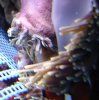
This is a shot now, the white thing is a turkey baister holding the healthy looking part back so you can see the disolving part.
 

Attachments

  • anemBad4.JPG
    anemBad4.JPG
    43.9 KB · Views: 315
Last edited:
The place it started having tissue disolve was on the side, but there was no cut or abrasion on the foot that I could see. It looked more like the "infection" came from the inside out. I had been seeing dark bad looking tissue (not poop) inside the mouth when it gaped.

I want to add the autotopoff to make keeping the salinity steady easier. I have been very carefull about not letting it flucuate since I added the anemone, but I think I could improve this a bit. There havn't been any big swings though.

I will definately pick one up the same day it comes in next time. I had had my doubts about the heallth of this one and let it stay in the store for over a week before I took it home. This one was not bleached at all and the tenticles were long, so I would assume it had been recently collected. In retrospect I would have taken it right away or not at all. I think I just let my impatience get the best of me in this case.

The anemone had started eating well, but never quickly. I was feeding krill, silversides and raw shrimp. It seemed to like the shrimp the best and the silversides the least. I would also get some cyclopseese and mysis to stick to the mouth tissue when I would feed the shrimp. It stopped eating about a month ago.

I don't think I could dip it because it is attached to two huge rocks.
 
Last edited:
It is hard to tell in the pictures, but there is a definate difference between showing a little stomach tissue sometimes and having a lose mouth. I think the tightness of the mouth is a good indication of the health and it wasn't there in this one. Color and tenticle length are the other things to look for and it was good in those two areas.
 
Back
Top