• ******* To read about the changes to the marketplace click here

STN - Possible Causes

DEIGNAN14

Well-Known Member
BRS Member
I know STN is hard to nail down. But I am starting to think I might have an infection or some kind of parasite in the system. I started loosing acros a few weeks ago. Been pulling things and fragging as fast as I can but things dont seem to be slowing down. This morning I found one of my milis covered in some kind of slime that I have never seen before. Looks like white specks on it too. Ive dealt with red bugs and I dont see any evidence of them. Any ideas on what else I should be checking? My params have been solid so I dont think this is a water quality issue. Any SPS freaks in the Watertown area?? Have beer :).
 
what is ur alk mag and calc level, bet u the beer that your alk is low ..................................
 
low KH or a sudden kh swing will usually cause an stn issue once u raise it back up....usually takes a week or so to rear it's ugly head...if it continues take the coral out with the issue & dip it in an iodine based solution for dipping corals... Or use some super glue gel on the base edge of the rtn...that will usually stop the bacteria present from continuing the recession...

HTH,
B
 
If you could post your current tank levels and if you have any of the older test results that would help to see how your tank is trending. Alk, Calc, Mag, Sg, Po4? prolly Alk dipped down but could be low saliinity.

more questions to help find the root of the problem-

Has there been any changes to the tank? lighting/bulbs,new reactors/equipments...things of that nature. Any large water changes recently?

What corals have you lost or had to frag?
Any frayed pump wires or possible stray voltage?
 
Are the "white specs" oval in shape and do they look like bite marks? Do you also see any eggs on the acros?

I would suspect AEFW if everything else is in order.
 
Thanks everyone! Sorry I was on a biz trip! The params have been solid. I have automatic dosers that have held ALK at 9.8 and CA at 450. I test frequently and things have been stable now for a couple months.

I run GFP and BP. I feed Phyto, Oyster eggs, Coral vitalizer (Zeo) Amino acids, mysis and pods. This event seemed to kick off when I added a batch of live mysis and some other live pods. At the same time, I started polhs amino acids as well.

Ive seen one Acro with spots on it that could be some sort of parasite. The rest are RTNing from the base up. Super glue didnt stop it. Fragging didnt stop it. So far everything that has started slowly died off.

The tank has been up since October 2011. My main concern lately has been that nutrient might be too low so I have been trying to feed more and feed more frequently. The rest of the tank is looking great - this is why I am thinking its some sort of species specific infection or parasite...
 
No stray current in the tank - no equipment or lighting changes. Ive lost Acros only. (my tyree bubble gum is receeding at the edges a bit).
 
Sometimes RTN just happens. If I were you I'd stop dosing all that stuff and stick with the basics for awhile. Run some GAC and dose your ca, mg, and kh additives. Who knows, maybe some of those other additives when combined cause RTN. If you have a camera take a few macros of your acros, you should be able to see eggs/pests when you blow the picture up on your computer screen. Check all in tank/sump equipment for defects, I once had an MP10 that exploded from rust. The pump still worked but had problems, I didn't discover the rust until I took it apart.
 
If the nutrients were too low you would more likely see faded colors, no growth, maybe stn and your lps would have issues also. I think you could have too much going on in that tank with the different filtration processes. There is no need to run GFO, BPs, Zeo products IMO. Many tanks have excellent growth and color without those methods. I tend to believe that we overthink our reef tanks when instead we would adhere to the KISS methodology. If you cut back on the filtration methods above and get back to good skimming, bi-weekly WCs, and keep your params in balance I bet your tank will turn around.
 
Sometimes RTN just happens. .

I dont think that RTN just happens...theres always a reason IME. Whether you know the reason is another story. I will agree that sometimes RTN events can happen by means other than your hand (ie coral warfare). However for the most part, RTN events can be linked to a decision/action the reefer keeper made. It can be difficult to identify the cause when other actions may have compounded the event thats why I always trace the last few changes Ive made regardless of significance to troubleshoot.
 
Thanks everyone! I have cut back all the zeo products and I am researching how to stop GFO and BP. I have heard that its not good just to shut them down. My params have been solid. Growth and color has been amazing (aside from this event). My concern prior to this STN outbreak was nutrients - thats why I increased feeding. Any suggestions on how to ween off of BP and GFO are appreciated. I really dont need either of them based on my bioload and my typical feeding.
 
BTW beers are still cold if there are any SPS junkies in the Watertown area!!
 
First, I think it's reasonably safe to say all RTN and STN is most likely ALWAYS, at least in part effected to some extent, by a predator or pathogen. It would be difficult to find any example, in biology, of similar tissue necrosis, that wasn't at least helped along by pathenogens for example. The pathenogens may be opportunistic, in other-words, they may not start it. For example, the coral may be weakened due to a stressor, such as a drop in alk, or lack of some food source. If it is bacterial infection (which a number of coral diseases are) BP, could even be feeding the pathogenic bacteria. Maybe iron from GFO is even feeding some bacteria. So, it's definitely worth trying some things. You may want to stop BP and GFO separately, and give it some time in between to see if things recover. If you do a bunch of things at once, you'll never know what the problem was, if it was one or the other.

IME, things aren't always as simple as some like to believe though. My tanks have done better, as I've learned to stop listening to everyone who things one thing is the cause of everything. Some may have more success treating things simply, but not all cases are the same though. Over time, you run into ones that aren't.

I recently had an issue after treating for red-bugs. I monitored alk daily and it was rock solid (I do agree alk swings are a very common stressor), but looking closer, I had some STN and found red bugs. I then treated, but some of the unaffected corals started stn'ing. I also noticed that these corals had PE before the treatment, but no PE after. Although, I know PE is not really a reliable sign of health, sometimes it may indicate stress and it is a feeding response. So, I thought that maybe there wasn't enough nutrients in the water column. I had already cut back on GFO quite a bit, as I was running a lot of vinager and vodka. I decided to cut back on the vinager and vodka, slowly to a quarter of what it was, thinking that it was driving bacteria. I got down to almost nothing, but STN was increasing and I was loosing a lot of corals. I then cut back on GFO, and the corals STN'd more! Finally out of desperation, I added back quite a bit of GFO, about twice what I was using before the red-bug treatment. Within a few days, a lot corals were showing PE again. Within a week, a lot of corals had colored back up, and within two weeks, some where showing new growth tips (growth had stopped entirely before). It's a few weeks latter, and everything really seems to be thriving again and I have ramped back up the carbon dosing without issue.

So, while one thing may help someone, the opposite may help another. Don't assume what works for someone will always work for you. Not much is known in the hobby, otherwise, the only appeal would be the pretty colors.... I can't say why GFO appears to have helped so much, but it does appear to have. Perhaps as I have historically run a lot of GFO, my corals were better adapted to such an environment. I don't know... Water changes also help a lot in my experience, so, that is something else to consider. In the past I've also found my corals are more prone to necrosis if I do much more or less than 10-15% weekly. However, some people do no water changes and others do more with success, so, no one has a magic formula for YOUR tank. What worked for them, may or may not work. All I can say is be systematic and take notes. There is lots of info out there regarding what has worked for some, see what works for you.
 
Last edited:
thats odd advice inverted. there are "formulas" for a successful reef tank...its not all smoke, mirrors and magic. everyones tank is a little different but many of the basic principals are the same. his thread was to get ideas and advice not to muddy the waters.

Deigan, any update on the situation? did you figure it out? or atleast turn it around?
 
thats odd advice inverted. there are "formulas" for a successful reef tank...its not all smoke, mirrors and magic. everyones tank is a little different but many of the basic principals are the same. his thread was to get ideas and advice not to muddy the waters.

LMAO, your saying that telling someone, if something doesn't work, don't assume you should continue to do it, just because a bunch of talking heads on the internet say to, is "odd advice".

Okay dude.

I also think it's a bit funny that your telling me that "its not all smoke, mirrors and magic" though. I've always gone out of my way to try to understand and explain what is going on in a system. You said that if "the nutrients were too low, you would more likely see faded colors, no growth, maybe stn and your lps would have issues also." Do you have evidence of that? why do corals do so well in the ocean then LOL? and why then, do you think that the issue is too much filtration? I'm certainly not the one that looks at a reef as a black box that can not be explained. I do realize that there are things we do not understand though and every system is different though.

When someone says "I feed Phyto, Oyster eggs, Coral vitalizer (Zeo) Amino acids, mysis and pods. This event seemed to kick off when I added a batch of live mysis and some other live pods. At the same time, I started polhs amino acids as well." The first thing I think is not that he has "too much filtration".
Perhaps he does have too much filtration, but how are you going from " this happened after I fed a lot" to "you have too much filtration"? If you think it isn't all "smoke and mirrors" then you should be able to explain your link from a to b... right?

If his concern is that nutrients are "too low" and he's be "feeding more frequently" and things are not getting better, but are getting worse, then perhaps nutrients are not "too low" but too high ;) Nutrients drive algae, internal symbiotic algae and external algae, both are may stress corals. It also drives bacteria, which can destabilize the delicate balance that is the coral holobiont. When symbiosis goes awry, you get a breakdown of symbiosis and the coral is prone to opportunist pathogens, i.e. you may start to see tissue necrosis. Feeding a lot and carbon dosing probably can result in such an occurrence, in some cases and I had agreed that cutting back on carbon dosing could be worth a try. I don't agree that you should assume that, that is the case and necessarily continue to cut back on carbon dosing, if things then get worse. Things often do follow general rules. Some including myself, find that a general rule is that corals, such as acropora generally do better in environments with low dissolved nutrients and minimal algae growth. People wouldn't dose carbon sources if some did not see a benefit to the health of their systems when doing so, such as this. Things are not a black box, but they are not always so simple. Too much carbon may cause issues, but so can too much nutrients.

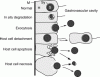
As described by Virgina M. Weiss 2008 "Cellular mechanisms of Cnidarian bleaching: stress causes the collapse of symbiosis", corals go through different phases of stress response.

F4.medium.gif


To get to full fledged necrosis very severe stress needs to occur. Recently, in the scientific literature, there is more and more evidence that the cause is pathogens and not a lot of the "hand of the reefkeeper" as many talking heads on the internet like to always attribute it too (not that reefkeepers aren't capable of killing corals as well, however, it is not always "alk overdoses" for example).

some examples:
http://green.blogs.nytimes.com/2011/08/18/in-the-first-known-case-human-bacteria-kills-coral/

http://www.plosone.org/article/info:doi/10.1371/journal.pone.0002393

http://onlinelibrary.wiley.com/doi/10.1111/j.1462-2920.2012.02746.x/abstract

High nutrients can likely drive bacteria via various means. If the solution to all necrosis issues was to raise nutrient levels, then people would have done much better with acros in the 80s and 90s. It is only in recent years, when more advanced filtration methods have become widely available that acros have become more common place in the hobby. Just my .02, but this isn't coincidence...

We can all strive to live in a simple reef world, where everything follows nice cook-book methodology and no thought is required, or we can look at the evidence and try to figure things out. Everyone has a preference on this and that fine, but don't flame me for assuming that people posting in an "advanced forum" are not looking for the simplest advice humanly possible..

 

Attachments

  • F4.medium.gif
    F4.medium.gif
    10.7 KB · Views: 444
Last edited:
Thanks again everyone. Ive been around this site for nearly a decade. Have learned to take it all with a grain of salt. I continue to fight the fight over hear. Its slowing down but still spreading. Iodide dip has helped slow the progression for some. For others it has accelerated it.
 
Dipping is a touchy subject. Invertebrates, such as coral, really don't have a full immune system. They actually seem to rely on a lot of symbiotic organisms, such as bacteria to help fend off predators and disease. Coral health is probably highly dependent on the balance of organisms living on and in the coral. Some (I believe Eric Borneman for example) tend to suggest dipping can kill these and weaken the corals defenses. On the other hand many aquarists find dipping helps (at lest short term, I'm not sure anyone has ever compared long term health of "dipped corals"). I tend to use dipping and sometimes if iodine doesn't work, coral RX will, or visa versa. So, I tend to try multiple dips. However, these don't always work. Another trick in that case is often super glue. Put a band around the leading edge of the dead tissue. Often this will stop the necrosis. If this doesn't work, then the best thing, in my tanks anyways, is usually water changes. Also, do keep looking for predators. Redbugs and flatworms can be really tough to see. If it goes away and after a while comes back, even with constant water changes, and low nutrients, that may a good sign that there is a predator.
 
By the way, since I mentioned water changes, I should also mention that it's been my experience that large water changes can accelerate necrosis. 10-15% twice per week for 3 weeks is my standard regime when other things are not working. At least combined with aggressive skimming, GAC and other filtration (usually skimming GAC etc.. I do anyways), I've turned around some really hurting tanks. That's just my experience though. As I said though, a lot of things are about balance. Too much or too little of something often causes the same negative result. So, I always stress caution in interpreting experience, there often is more than meets the eye and it's tough to gauge the best direction for action.
 
how's your temp been? With the recent wave of heat, I wouldn't count that out. STN RTN...usually ph and alk
 
temp is solid. I have central air :) PH is also within an acceptable range according to the charts...
 
Back
Top