• ******* To read about the changes to the marketplace click here

Vodka Dosing or Vinegar in your Kalk or Both

JPags

Well-Known Member
BRS Member
I have been vodka dosing for while now and have 0 nitrates in my tank.

I just started dripping kalk and have read that by adding Vinegar to your kalk you help the chemical reaction and you also have a left over carbon source for your tank.

I am wondering if any of the chemists out there can tell me if I am doing both the vodka dosing and vinegar in my kalk is that too much carbon for my tank? I have not noticed any issues yet. Is the carbon left over from the vinegar minimal?

Thanks

JPags
 
Found this info on adding vinegar to kalk to answer some questions. Not that I use this method, I had to look for info pertaining to the method to the madness.vinegar+kalk=happycorals

Briefly:
First, it will get more Calcium ions (Ca++) into the solution because you are dissolving the Ca(OH)2 in an acid instead of water, and forming Calcium Acetate, which exists as a dissociated equilibrium of free Calcium ions and Acetate ions.
Second, the Acetic Acid (Vinegar) provides an equivalent of all the CO2 you need to avoid precipitating the newly-added Calcium ions as useless white Calcium Carbonate powder.
Third, after all the cool Calcium ion chemistry is over, the leftover Acetate ions from the broken-down Vinegar leaves you with free organic Carbon in the water that feeds the bacteria in your tank so that it converts more poisonous Nitrates to NO2 gas (a very good thing).
 
Here's a really in depth piece about adding vinegar to kalk...

http://www.reefscapes.net/articles/breefcase/kalkwasser.html

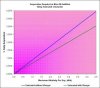
Also here's a nice chart showing how vinegar helps...

Opps thought that would be a little bigger but the blue line is without vinegar and green bottom line is with vinegar showing you can add more saturated kalk in less top off...
 

Attachments

  • Evaporation.jpg
    Evaporation.jpg
    15.9 KB · Views: 2,166
So this seems simple enough, what is the down side??

To avoid this, try mixing and adding your Kalkwasser like this: pour 15ml of 5% Acetic Acid (or ordinary Distilled White Vinegar from the grocery store -- same thing) into a 1 liter (1 quart) container. Dissolve 1/2 teaspoon of lab-grade Ca(OH)2 (or commercial Kalkwasser mix) in the Acetic Acid, and then dilute to 1 liter (1 quart) volume with either RO/DI water, or even tank water.
 
I was dosing 1.2ml per day of Vodka, this is after following the instructions on dosing and getting to 2.4ml per day to get to 0 nitrates and then cutting it in half, but I have stopped the vodka for a bit to see if the vinegar will add enough carbon to keep the nitrates away without the vodka. I also noticed that with both, I was getting more of the bacteria strands in my tank so one source may be enough.

I also read another article that said only 15ml vinegar/gal. Another article states 15ml per liter which I think may be a lot.

John
 
>So this seems simple enough, what is the down side??<

Down side is you are adding nutrients to your tank in the form of a carbon source. For some tanks this might be good, for others might not be good.
 
I am wondering if any of the chemists out there can tell me if I am doing both the vodka dosing and vinegar in my kalk is that too much carbon for my tank? I have not noticed any issues yet. Is the carbon left over from the vinegar minimal?

Thanks

JPags

Jpags, I'm not much of a chemist by trade but the simple answer is yes you can use vinegar as a carbon source. If the amount you use is not enough to keep nitrates in check you can add a smaller amount than previous of vodka to correct it. For simplicity you could add both to your top-off i needed.
 
not much of a chemist either, but when I mix the vinegar with the kalk it doesnt really disolve, can the vinegar be added to the top off water without the kalk?

thanks Frank
 
Frank180reef, the kalk should dissolve pretty close to completely in the water. When you add the vinegar you should see a bit more go into solution. This little going into solution upon vinegar addition is why you get a little extra calcium added. And yes you can use just vinegar but have to be worried about growth of bacteria in your feeder line to the aquarium. I don't worry about it too much but do clean it 4x a year.
 
So nothing scientific, but I have been dosing with vinegar. I tested my nitrates yesterday and they were 5-8 ppm. I have a 7 yo dsb, 350g of water...I have 10 or so fish, including the large emperor angelfish. The nitrate level was tested with a Salifert test kit.

thanks Frank


I am not a chemist so I have some links below that show some of the possible
chemistry. You could even get Sterno from mixing these chemicals.
Many "chemist" use the over simplification of this reaction.
Ca++ + 2(OH-) + 2(CO2) <==> Ca++ + 2(HCO3-)
I am sure the reaction occurs but if CaOH2 reacts with other salts or carbon
sources to precipitate out adding vinegar and alcohol might lower available
carbon.
When you add Calcium ions to salt water they react in many different ways.
The equation above is only one of many. I am not sure how they would
define the equilibrium of the many calcium salts created. Perhaps a chemist
might have a link to a paper or research further defining the complex interaction.
I believe that 5-8 ppm nitrate in a 350 gallon tank with 10 or so fish is achievable with no additions. I also believe the discussions on phosphate chemistry in these threads
starts to give a better idea of the complexity of the question. Much of what is written
on saltwater chemistry in these pages is at the science level of infomercials.


http://wiki.answers.com/Q/What_is_t...eaction_of_acetic_acid_with_calcium_hydroxide
2CH3COOH(aq)+1Ca(OH)2(s)---2H2O(l)+1Ca(CH3COO)2(aq)
http://en.wikipedia.org/wiki/Calcium_acetate
Calcium acetate
The chemical compound calcium acetate is the calcium salt of acetic acid. It has the formula Ca(C2H3O2)2. Its standard name is calcium acetate, while calcium ethanoate is the systematic IUPAC name. An older name is acetate of lime. The anhydrous form is very hygroscopic; therefore the monohydrate (Ca(CH3COO)2.H2O, CAS [5743-26-0]) is the common form.

If an alcohol is added to a saturated solution of calcium acetate, a semisolid, flammable gel forms that is much like "canned heat" products such as Sterno.[1]


Calcium carbonate and vinegar (ethanoic acid) will react in a Lewis acid/base reaction to yield calcium acetate, carbon dioxide, and water.

 
anyone have any updates on this, I have been dosing with vinegar, my nitrates are zero and my skimmer is pulling TONS of stuff out

Frank
 
I used to use it but stopped as well...
so they will neutralize each other until balanced and then the Kalk will continue to saturate, so you are not actually getting more into solution, just using more.

I'm not sure what you mean by that. Adding vinegar does make more solid lime dissolve and delivers more calcium and alkalinity to the tank. You can get about 1/3 more to the tank if you add 45 ml of vinegar per gallon of top off water.


That said, I do not recommend that folks go the vinegar route unless they are sure they need it. The acetate from the vinegar can drive bacterial growth and possibly reduce O2.

This was interesting on the vinegar perspective..
" Expanding the Limits of Limewater: Adding Organic Carbon Sources

A few words of caution:

1) Dr. Craig Bingman is the guy who originally suggested adding vinegar to Kalkwasser in this article from October 1999.

2) In that article, Craig recommends a MAXIMUM of 12.2 ml of vinegar per liter of Kalkwasser. That's three tablespoons per gallon of Kalkwasser.

3) Craig then adds the following caveat: "Again, this is the maximum concentration of acetic acid that one would add, and, in practice, I would suggest adding no more than a quarter of this quantity to see how your system tolerates it."

4) The maximum amount of powdered calcium hydroxide that you can get to dissolve per gallon of freshwater (without adding any vinegar) is two teaspoons. Two teaspoons per gallon of freshwater will result in a saturated solution.

5) I have personally added vinegar to freshwater before adding the Mrs. Wages but I used 1 Tbsp per gallon of freshwater (1/3 the maximum). I increased the Mrs. Wages from two teaspoons per gallon to one tablespoon per gallon to make sure I was adding enough.

6) After reading comments on this subject by Dr. Randy Holmes-Farley, I discontinued adding vinegar at all. I became convinced that this is something that should be used only if your system's calcium demands are not being met with normal Kalkwasser additions and you don't want to purchase a calcium reactor.

7) Randy does not personally use vinegar. He prefers to not use it. He sees nothing wrong with Craig's recommendations provided you do NOT exceed the maximum of three Tbsps/gallon and even Craig recommends using LESS than the maximum. Under no circumstances should you exceed the maximum because you're screwing up the chemical equilibrium in your tank and will get your calcium-alk-pH balance out of whack.

8) Kalkwasser is self-purifying. A lot of the sediment you see in the bottom of the mixing container is nasty stuff (like heavy metals) that you don't want to add to your tank. Therefore, precipitation in the Kalkwasser mixing container is a good thing. Adding a lot of vinegar reduces this "good thing" effect.

The bottom line is that it's OK to use vinegar if you really need to do that to boost the amount of calcium hydroxide that will go into solution but it's not something that should be done unless you really need to do it and it's definitely not something that should be over-done."
http://74.125.93.132/search?q=cache:d9B3lHucL6oJ:www.reefland.com/forum/tanks-filtration-basic-equipment/20812-vinegar-2.html+holmes-farley+vinegar&cd=5&hl=en&ct=clnk&gl=us
 
Back
Top