• ******* To read about the changes to the marketplace click here

New type of sump silencer

FishyIdea

Non-member
I managed to get my sump a little quieter by concocting a new design (new to my world anyway) from all the tricks I learned from other threads.

I've been calling it the "sump muffler" or the YAWOP (yet another waste of PVC).

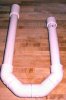
Here's a pic of the inner assembly.
 

Attachments

  • sumpmuffler1.jpg
    sumpmuffler1.jpg
    60.2 KB · Views: 323
Working from the top left, the first piece is a standard 1" to 1" coupling, which attaches to the main drain from the overflow.

Next you have a length of 1" pipe that is long enough to make sure the whole assembly rests on the bottom of the sump.

Next you have four 45 degree elbows attached with small bits of flexible PVC.

Now you have a riser pipe with a bunch of 1/4" holes (16) drilled at the top.

Finally you have a cap with no holes drilled in it.
 
Now you need a length of 3" PVC.

I decide it should be as tall as possible without risking the long term damage possible by spraying wet air onto the inside wood of the cabinet top.

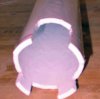
You need to cut out a hole in the bottom so that the riser pipe side of the drain can go inside the middle of this pipe and be directly centered in it, as concentric circles.

Then you need to cut three more slots so you have plenty of space for water to escape and still have four little feet to stabalize the assembly.

Here is a pic.
 

Attachments

  • sumpmuffler2.jpg
    sumpmuffler2.jpg
    30.8 KB · Views: 313
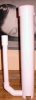
The top of the pipe is stuffed with poly and covered with a cap that has a 1/4" hole for the air to escape.

If you put too much poly in there, it will get soaked and dirty and need to be changed regularly.
 

Attachments

  • sumpmuffler3.jpg
    sumpmuffler3.jpg
    41.2 KB · Views: 310
The whole assembly
 

Attachments

  • sumpmuffler4.jpg
    sumpmuffler4.jpg
    41 KB · Views: 290
In place...
 

Attachments

  • sumpmuffler5.jpg
    sumpmuffler5.jpg
    95.4 KB · Views: 316
Warning: If you have a Durso, you may need to retune your hole size to keep the flow rate acceptable. In my case I made it a little smaller. (Perhaps the water slowed down through the drain and required less air?)

The height of the rise pipe is one thing I experimented with:

A: Holes of the riser pipe are submerged by a couple of inches. Lots of small bubbles escape from bottom, but do not make it past baffles to return pump.

B. Holes of riser pipe at water line of sump. Fewer bubbles.

C. Holes a couple of inches above water line. Very few bubbles. Polyfill more likely to be very wet.

I did not discern any appreciable difference in noise with the three settings. I would have to tape record the three scenarios and play them a few times to see if any setting produces a more or less pleasing noise.

I have another 3" cap, so I'm going to experiment with adding more holes.

Another possibility is to add more holes to the riser pipe and see if that helps.

Any thoughts?

Joe
 
Back
Top