• ******* To read about the changes to the marketplace click here

question on bonding acrylic

quanctran

Non-member
I try to build my sump out of acrylic. and i kind of having a problem on bonding them using weldon #4. When i bond the two pieces of acrylic together with the pin technique i always end up with extra weldon once the pin removed. and it look like a messy job. I worry if i put not enough it would end up as a bad bond.

Anyone know how to do a strong bond and a clean job?

If it seem like a weak bond or bubbled, How to fix it?

I heard that i can fill up the gap or weak bond with weldon #16. but whenever i add it in. it getting messy cause it come straight from the bottle. Help :D
 
oh yea, can i wipe that that extra weldon from the edge after the pin removed? or that would damage the acrylic.
 
I haven't used it a lot but my experience is Weldon 16 is easier to use than 4.It does not take a lot just a small bead will do and if you use more it won't make it stronger(might even weaken the joint).I don't think it's a "glue" as it chemically melts the acrylic together.You can wipe off the excess but it will be permanently smudged wherever it was/is.Air bubbles....too much glue?
 
If you wipe the excess away it will look much more messy than if you just let the excess evaporate. Leaving the protective paper on will help a lot in protecting the appearance of the acrylic, peel it back just enough where needed.

For the joints leave some overlap then clean it up with a flush cut router bit.

For good seams, the quality of the edge on the acrylic makes a big difference. It's a good bit harder to get nice seams when the sheet has been cut on a table saw as compared to a router.

What kind of acrylic material are you using? How thick are the pins your using?
 
not sure what kind og acrylic. it 1/4 thickness. the pin is like really thin less than 1 mm. guess it come to skill and experience when doing these bond. =)
 
The kind of material is very important. Look at the protective paper/film on the sheet, what's it look like and does it say anything?
 
the paper is plastic and no word on it. it blue
 
Huh,

I thought pins were used for bonding glass together with silicone?
Learn something new everyday...
 
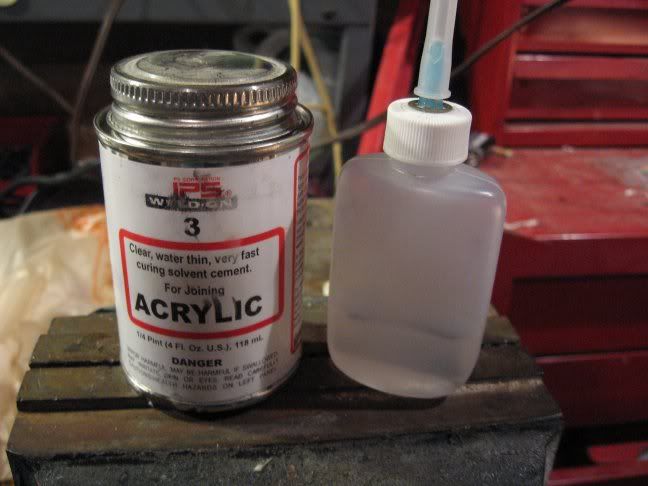
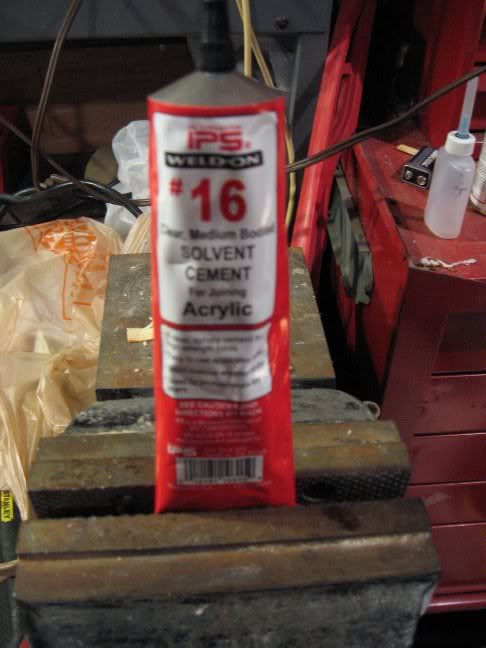
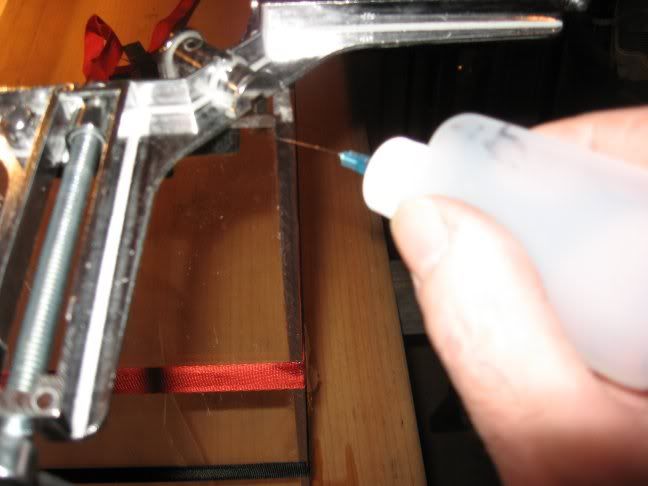
Acupuncture needles are what's suggested as a spacer to allow the Weld on to weep between the 2 pieces of acrylic. Shim stock is applied under the acrylic to apply pressure from beneath. A small bottle is used with a needle type metal tip is used to apply the Weld on. Use an eye dropper to suck up from the can into the bottle to use what you'll need, pour any extra back as it will evaporate. You can see the Weld on 3 wick between the acrylic as its applied. As willray says Weld on 16 works better than 4 in which 4 is very watery so Weld on 3 is commonly used. Weld on 16 has a consistency simuliar to super glu gel to chemically adhere two acrylic pieces to a bond.

Acrylic3.jpg

Acrylic16.jpg

Applysealeant1.jpg
 
On 1/4" stock with weldon #3 and the applicator bottle, you can get away without using pins. .. although I 've seen Gustavo use the pins and the joint is perfect.

When I built my sump (pics somewhere in this DIY forum), I just clamped it and let the Weldon wick. If I had it to do over again, I would have routed the edges.
 
the paper is plastic and no word on it. it blue


I'm not expert with acrylic but I do have a deccent basic working knowledge.......

That doesn't sound like the best material to work with. I'm guessing it's lexan or something like that from HD/lowes?

All the acrylic materials that I've seen that are cooperative to work with come with a brown paper looking protective sheet with an adhesive film inside. Usually some printing on the paper but sometimes none. "Acrylite" and "Plexiglass" are good brands, but each also have a range of different materials sold under those names. It can get kind of complicated and I really don't know enough to expalin in any detail....

Anyway - I'm not too sure on the bonding qualities of other plastic materials (ie any of the clear or blue plastic film covered ones I've played with) but IME they are all quite hard to cut/machine cleanly. Usually a lot of melt and chipping. Grabby and scary on the router.

If you can't cut it cleanly, you might have major problems making anything strong with it?


On the "Pins method"
Yes, quite common for acrylic work. I use .010" or .012" metal guitar strings. You want the seams a little wet at first because as the solvent cures it evaporates so the puddles shrink. If the solvent along the seams is too little, the curing/evaporation process will suck in little bubbles making a weaker and less clean looking seam.

On weld-on
I've only used #4 and #16, can't comment on the difference between #3 and #4 (but I'd love to hear what others have to say?).
#4 makes a MUCH stronger bond than #16. #16 is like toothpaste and you can make repairs with it effectively. It's like smearing a strong glue over the outside of a bad seam to fix it. #4, if used right, will solidly melt the different acrylic peices into one, ie the seam is truely welded together.

HTH

 
Adding on to my last post;

I spoke with Gustavo today about weldon and pin sizes. The # is just a bit more waterier than the #4. He said he likes the #3 better for most things because it wicks into the seams a little better.

He also said he uses slightly thicker pins than what I've been using. He said around 1.020 for most projects.
 
I bought a brand called "crystalite" from HD today in leominster, making my 48x16x16 summp with it. It looks identical to "acrylite" which i used before, same price too ($40 for 48x24 sheet). This glues the same with weldon 4 as far as i can tell so far. I dont really use the pins, i just try and clean the sides with a flush bit router and let the weldon 4 seep in by itself. Its pretty clean bond. Any dubious joints i reinforce with little strips of scrap acrylic for extra strength.
 
Back
Top